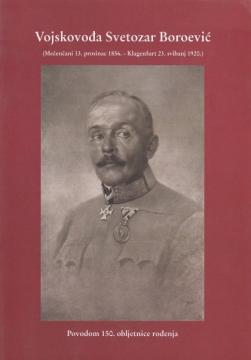
Vojskovođa Svetozar Boroević 1856-1920.

Vojskovođa Svetozar Boroević 1856-1920.

Milan Pojić

Svetozar Boroević, the most capable Austro-Hungarian military leader of the First World War, the only Croat who received the title of field marshal and was awarded the highest Austrian decorations, has been systematically hushed up in Croatian history.

"Ignorance of the basic facts about Svetozar Boroević, and even more the assessment of his person and works by the politicians of the subsequent state formations in which Croatia found itself, from monarchist to socialist Yugoslavia, turned the great military leader and Croatian patriot into a victim of stereotypes. The first, and a similar fate followed ban Josip Jelačić for a long time, is that Boroević is more of an imperial/Austro-Hungarian general and military leader, and less of a "Croatian/Yugoslav patriot". He cares more about the salvation of the Monarchy than about the interests of the Croatian homeland and the Croatian people. Another stereotype is that he was born into an Orthodox border family, so he is therefore a Serb. This stereotype, which was very successfully promoted by the Serbian Orthodox Church and accepted by the wider Croatian public, led to the fact that in the last biography of Boroević published in 1989 in the Croatian Biographical Lexicon, the Miroslav Krleža Lexicographic Institute in Zagreb considered it necessary to mention that Boroević was "of origin is from a Serbian border family". None of the above stereotypes is correct."

Translation
Danijela Marjanić
Dimensions
24 x 17 cm
Pages
31
Publisher
Hrvatski državni arhiv, Zagreb, 2006.
 
Latin alphabet. Paperback.
Language: Croatian.

One copy is available

Condition:Used, excellent condition
Discounted price: 5.464.37
20% discount is valid until 12/10/25 11:59 pm
 

Are you interested in another book? You can search the offer using our search engine or browse books by category.

You may also be interested in these titles

Hrvatsko proljeće

Hrvatsko proljeće

Miko Tripalo

The Croatian Spring is not only a chronicle of the events of 1971, but also a suggestive presentation of the political conditions of Yugoslavia in the post-war period. These testimonies come from the pen of a man who really tried to break the shackles of

Globus, 1990.
Croatian. Latin alphabet. Hardcover with dust jacket.
11.589.26 - 13.36
Matica hrvatskih umirovljenika - Gradsko udruženje Osijek 1946-1996.

Matica hrvatskih umirovljenika - Gradsko udruženje Osijek 1946-1996.

Vinko Žiroš, Jaroslav Bouše, Marija Vukelić, Miroslav Kasabašić, Šešo Marija
Gradsko udruženje, 1996.
Croatian. Latin alphabet. Paperback.
2.42
Stepinac

Stepinac

Živko Kustić
Studio promotion, 1991.
Croatian. Latin alphabet. Paperback.
4.82
Tvornica olovaka u Zagrebu : 40 godina rada i razvoja 1937 - 1977

Tvornica olovaka u Zagrebu : 40 godina rada i razvoja 1937 - 1977

TOZ, tvornica olovaka, školskog i kancelarijskog pribora, 1977.
Croatian. Latin alphabet. Hardcover.
14.9811.98 - 14.98
Prilog građi za historiju NOP Slavonije 1941

Prilog građi za historiju NOP Slavonije 1941

The book contains authentic documents, reports, orders, proclamations, minutes, statements of participants and other types of archival material relating to the activities of the NOP in Slavonia during 1941.

Historijski institut Slavonije, 1965.
Croatian. Latin alphabet. Hardcover.
8.98
Na vratima naroda, na granici svjetova

Na vratima naroda, na granici svjetova

Davorin Taslidžić

At the gates of nations, at the border of worlds, it enriches all our previous knowledge by spreading all kinds of insights because it is composed of contributions that are certainly the fruit of serious work, but also of deliberation.

Zavod za Baranjsku povjesnicu, 1999.
Croatian. Latin alphabet. Paperback.
10.28