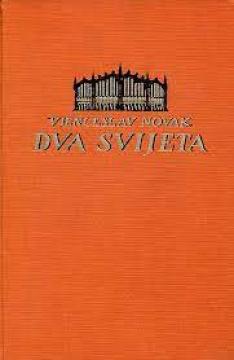
Dva svijeta
Antiquität

Dva svijeta

Vjenceslav Novak

A psychological novel about musician Amadej Zlatanić who, after studying in Prague, returns to Croatia, where he faces the misunderstanding of his petty-bourgeois surroundings and ends up in a madhouse. The conflict between artistic ideals and reality.

The main character is Amadej Zlatanić, a talented musician and composer. After successfully studying at the conservatory in Prague, full of artistic ideals and European musical influences, he returns to his native Croatia. Instead of the expected understanding and opportunities for creativity, he encounters a provincial petty-bourgeois environment*, social conventions, material concerns and a complete lack of understanding of his surroundings.

The novel masterfully depicts the clash of two worlds: the inner, ideal world of art, music and creative freedom versus the outer, crude, utilitarian and culturally backward world of Austro-Hungarian Croatia at the beginning of the 20th century. Novak, who was himself a music pedagogue, uses music as a key motif and metalanguage – descriptions of compositions, organ improvisations and Amadej's inner experiences of music pass into poetic and symbolic layers, showing the hero's creative process and spiritual disintegration.

Gradually, Amadeus's artistic integrity collapses under the pressure of social norms, financial problems, loneliness, and lack of cultural stimulation. The novel culminates in his mental breakdown and ending up in a madhouse – a classic motif of the downfall of a sensitive intellectual in a hostile environment.

The work emphasizes the themes of the loneliness of the artist, cultural backwardness, the conflict between the individual and society, and the duality of the apparent and the imagined. Novak successfully combines realistic social analysis with deep psychological introspection, using the musician's own experience for rich musical descriptions.

Editor
Slavko Ježić
Maße
22,5 x 15 cm
Seitenzahl
206
Verlag
Minerva nakladna knjižara, Zagreb, 1932.
 
Latein Schrift. Hardcover.
Sprache: Kroatisch.

Es werden zwei Exemplare angeboten

Kopiennummer 1

Zustand:Gebraucht, in sehr gutem Zustand
Zum Warenkorb hinzugefügt!

Kopiennummer 2

Zustand:Gebraucht, in gutem Zustand (Gebrauchsspuren)
Nachteile/Unannehmlichkeiten:
  • Mrlje na poklopcu
  • Tragovi patine
Zum Warenkorb hinzugefügt!
 

Interessieren Sie sich für ein anderes Buch? Sie können das Angebot über unsere Suchmaschine suchen und finden oder Bücher nach Kategorien durchsuchen.

Diese Titel könnten Sie auch interessieren

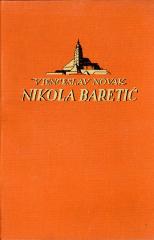
Nikola Baretić

Nikola Baretić

Vjenceslav Novak

Nikola Baretić prati sudbinu glavnog junaka u senjskom kraju, suočenog sa ljubomorom, bračnim sukobima i društvenim pritiscima. Realistički roman o strastima, časti i propadanju u malograđanskoj sredini 19. veka.

Minerva nakladna knjižara, 1932.
Kroatisch. Latein Schrift. Hardcover.
4,99 - 5,76
Izabrane pripovijesti

Izabrane pripovijesti

Vjenceslav Novak
Matica hrvatska, 1925.
Kroatisch. Latein Schrift. Hardcover.
Das Buch besteht aus vier Bänden
16,99
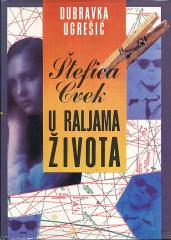
Štefica Cvek u raljama života

Štefica Cvek u raljama života

Dubravka Ugrešić

Volite li “ljubiće"? Što god mislili o njima, uživat ćete u ovom vrhunskom pastišu trivijalnih ljubavnih romana.

Mladinska knjiga, 1990.
Kroatisch. Latein Schrift. Fester Einband mit Schutzumschlag.
4,94
Pripovetke iz levog i desnog džepa

Pripovetke iz levog i desnog džepa

Karel Čapek

Ove priče bave se različitom tematikom mada se većina bavi različitim kriminalnim radnjama, od prevara i gatanja do bračnih prevara i ubistava.

Jugoslavijapublik, 1980.
Kroatisch. Latein Schrift. Hardcover.
5,22
Rudnik čvaraka

Rudnik čvaraka

Tomislav Šovagović

Debitantsko djelo hrvatskog pisca Tomislava Šovagovića, nagrađeno nagradom Josip i Ivan Kozarac 2012., posveta je Slavoniji – regiji djetinjstva koju autor, rođen u Dalmaciji, promatra stranim, ali nježnim očima.

Mozaik knjiga, 20112.
Kroatisch. Latein Schrift. Taschenbuch.
11,56
Deobe 1-3

Deobe 1-3

Dobrica Ćosić

Ovo djelo, nagrađeno NIN-ovom nagradom za tu godinu, smatra se jednim od najznačajnijih u srpskoj književnosti nakon Drugog svjetskog rata. Prvo izdanje.

Prosveta, 1961.
Serbisch. Kyrillisch Schrift. Fester Einband mit Schutzumschlag.
Das Buch besteht aus drei Bänden
11,42