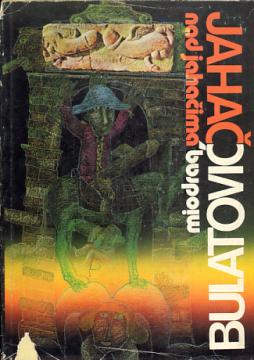
Jahač nad jahačima

Jahač nad jahačima

Miodrag Bulatović

A novel about the absurd, power and downfall of a man obsessed with greatness. In a symbolic, grotesque world, the author exposes the cruelty of power and madness in which ambition and fear blur the line between man and beast.

The novel The Rider of Riders (published in 1966) is one of the most significant and complex works by Miodrag Bulatović, a writer known for his grotesque expression and exploration of the dark depths of the human psyche. The work is an allegory of violence, deformed morality, and the spread of madness in societies that idolize power.

The action takes place in a closed, symbolic space resembling a totalitarian world in which the "rider" appears — a figure of power, obsessed with his own greatness and superiority over others. His rise and fall are depicted through the prism of fantastic and grotesque scenes, in which reality loses its shape, and the line between oppressor and victim disappears.

Bulatović uses strong metaphors, dense language, and a mixture of black humor, irony, and brutal realism to depict the dehumanization and destructiveness of power, but also man's inner need for submission and domination. The novel is imbued with an atmosphere of anxiety, visions and madness, which makes it close to the tradition of Dostoyevsky and Kafka, although it retains southern, Balkan poetics.

At the center of Riders over Riders is not only the dictator, but also the mass that supports him and feeds his power — Bulatović thereby opens up the question of responsibility, collective fear and moral failure. Due to its symbolism, aesthetic power and universal themes, the novel is counted among the masterpieces of modernist and existential prose of former Yugoslavian literature.

Maße
24 x 17 cm
Seitenzahl
143
Verlag
Partizanska knjiga, Beograd, 1980.
 
Latein Schrift. Fester Einband mit Schutzumschlag.
Sprache: Serbisch.

Angeboten wird ein Exemplar

Zustand:Gebraucht, in schlechtem Zustand
Zum Warenkorb hinzugefügt!
 

Interessieren Sie sich für ein anderes Buch? Sie können das Angebot über unsere Suchmaschine suchen und finden oder Bücher nach Kategorien durchsuchen.

Diese Titel könnten Sie auch interessieren

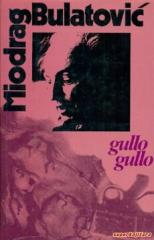
Gullo Gullo

Gullo Gullo

Miodrag Bulatović

Gullo Gullo is a grotesquely powerful novel about the moral and spiritual decay of a human being. In a world of violence, fear and absurdity, the main character wanders between life and death, good and evil, in search of meaning in a tragically twisted re

Prosveta, 1983.
Serbisch. Latein Schrift. Fester Einband mit Schutzumschlag.
2,82
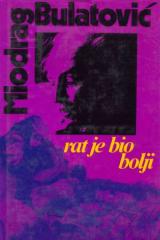
Rat je bio bolji

Rat je bio bolji

Miodrag Bulatović

Conceived and realized as a separate entity, this novel can also be interpreted as the second part of the book "The Hero on the Donkey." To a greater extent than in "The Hero," here the war "which was better" is depicted as a gigantic burlesque and a pool

Prosveta, 1983.
Serbisch. Latein Schrift. Fester Einband mit Schutzumschlag.
2,99
Shannonov put

Shannonov put

Archibald Joseph Cronin

Cronin's moving story of redemption. Robert Shannon, a fanatical doctor-researcher, sacrifices love and life for science, but in the end loses everything – his girlfriend, recognition, health – only to realize through suffering: medicine without humanity

Otokar Keršovani, 1966.
Kroatisch. Latein Schrift. Fester Einband mit Schutzumschlag.
6,24
Crna kutija

Crna kutija

Amos Oz

The Black Box is a kaleidoscope of married life and love relationships. It is a novel that implicitly speaks about all of us.

Hena Com, 2001.
Kroatisch. Latein Schrift. Hardcover.
10,98
I ne reče ni reči

I ne reče ni reči

Heinrich Böll

In Boll's novels, one of the central themes is the attempt to preserve basic moral values ​​in a time of terror, as well as in a period of material prosperity and corruption.

Svjetlost, 1965.
Serbisch. Latein Schrift. Taschenbuch.
3,22 - 3,98
Ljubičice u srijedu

Ljubičice u srijedu

Andre Maurois

André Maurois, a French writer known for his psychological novels and biographies, explores themes of family relationships, love, and internal conflicts in this work, which is characteristic of his style.

Svjetlost, 1965.
Kroatisch. Latein Schrift. Taschenbuch.
3,42 - 3,62