Zofija Kossak-Szczucka
Zofija Kossak-Szczucka (née Kossak, later Szatkowska; 10 August 1889, Kośmin, Volhynia – 9 April 1968, Bielsko-Biała) was a Polish Catholic writer, publicist and heroine of the resistance in World War II.
She came from the famous artistic family of Kossak (granddaughter of Juliusz Kossak, niece of Wojciech Kossak). She spent her childhood and youth in Volhynia. She studied painting in Warsaw, but turned to literature. She made her debut in 1922 with the novel Pożoga (Fire), an autobiographical account of the horrors of the Bolshevik Revolution and the Polish-Soviet War in eastern Poland. In the interwar period, she became one of the most popular Polish writers of Catholic orientation.
Most important works:
- Krzyżowcy (Crusaders, 1935) – a monumental historical novel about the Crusades
- Król trędowaty (The Leper King, 1936)
- Bez oręża (Blessed Are the Meek, 1937) – about St. Francis of Assisi, translated into several languages
- Złota wolność (Golden Freedom, 1928)
- Beatum scelus (1924)
- Legnickie pole (Legnińsko Field, 1930)
- Z miłości (From Love, 1925/26) – about St. Stanisław Kostka
- Szaleńcy Boży (God's Madmen, 1929)
She also wrote short stories, children's books, non-fiction and memoirs. Her historical novels combine exciting plots, deep Catholic faith and national pathos.
During the German occupation, she was active in the underground. She edited illegal newspapers, in 1941 she co-founded the Front Odrodzenia Polski (Polish Renewal Front), and in 1942 one of the founders of Żegota – a secret organization for rescuing Jews. Despite her own earlier anti-Semitic views, she publicly protested against the Holocaust (article Protest! 1942) and risked her life saving the persecuted. Arrested in 1943, imprisoned in Auschwitz (number 64491), later in Pawiak where she was sentenced to death, but was released thanks to the underground. She also participated in the Warsaw Uprising.
After the war, she emigrated to England (later France), where she continued to write. She returned to Poland in 1957 and lived in Górki Wielkie. She died in 1968. In 1982, she was declared Righteous Among the Nations.
Zofia Kossak-Szczucka remains a symbol of courage and the complex Polish soul of the 20th century – a writer who, out of faith and patriotism, crossed the boundaries of prejudice and became a heroine of humanity. Her works, especially the Crusader trilogy, are still read in Poland today and in translation.
Titles in our offer
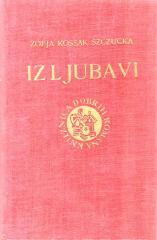
Iz ljubavi
Out of Love (1925/1926) is a hagiographic novel for young people. It tells the story of St. Stanisław Kostka, the youngest Polish saint – the son of a nobleman who rebels against his family, flees to Rome and joins the Jesuits out of a deep love for God.