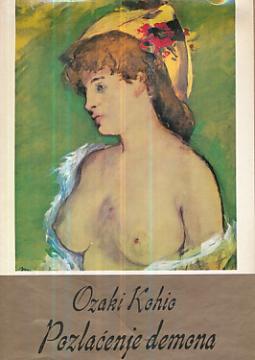
Pozlaćenje demona

Pozlaćenje demona

Ozaki Kohio

The Japanese classic depicts the tragic conflict of love and greed through the fate of a groom who is abandoned by his fiancee for wealth, turning him into a heartless and vengeful usurer.

The novel The Golden Demon (Konjiki Yasha), published in the late 19th century (1897–1902), is one of the most famous and influential works of Japanese literature from the Meiji era, authored by Ozaki Kōyō. The plot follows the tragic fate of Kanuki Kanji, a young man whose life falls apart when his fiancée, Miya, leaves him to marry a wealthy banker. Deeply hurt and betrayed, Kanji abandons his academic dreams and moral principles to become a ruthless, cold-blooded usurer—figuratively "becoming a demon" obsessed with money. Through this dramatic tale of heartbreak and revenge, Kōyō offers a sharp social critique of turn-of-the-century Japan. It was an era of rapid modernization and Westernization, in which traditional moral values, loyalty, and sincere emotions were giving way to a new deity: material wealth and social status. His distinctive, elegant, and dramatic writing style (known as gabuntai) left an indelible mark on the development of the modern Japanese novel. Although the author passed away before he could fully complete the work, The Golden Demon remains an enduring classic that has inspired numerous theatrical, film, and television adaptations.

Original title
Kondziki jasja
Translation
Vlastimir Đaković
Editor
Milivoje Marković
Graphics design
Hašim Kablarević
Dimensions
20 x 14.5 cm
Pages
318
Publisher
Minerva, Subotica, 1984.
 
Distribution: 10,000 copies
 
Latin alphabet. Hardcover with dust jacket.
Language: Serbian.

Two copies are available

Copy number 1

Condition:Used, excellent condition
Damages or inconvenience notice:
  • Traces of patina

Copy number 2

Condition:Used, excellent condition
Damages or inconvenience notice:
  • The cover is missing
 

Are you interested in another book? You can search the offer using our search engine or browse books by category.

You may also be interested in these titles

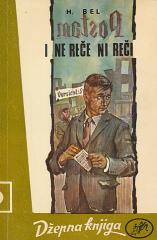
I ne reče ni reči

I ne reče ni reči

Heinrich Böll

In Boll's novels, one of the central themes is the attempt to preserve basic moral values ​​in a time of terror, as well as in a period of material prosperity and corruption.

Svjetlost, 1965.
Serbian. Latin alphabet. Paperback.
3.22 - 3.98 €
Proces

Proces

Franz Kafka

Kafka wrote The Process between 1914 and 1915, published posthumously in 1925. The novel is unfinished but with an added final chapter by Max Brod. Edition with a foreword by B. Živojinović and an afterword by Walter Killi.

BIGZ, 1990.
Serbian. Latin alphabet. Paperback.
4.26 €
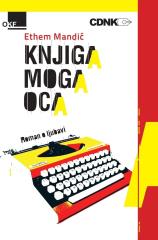
Knjiga moga oca

Knjiga moga oca

Ethem Mandić

This is a biography about my father made up of memories and mere imagination. History does not exist, and neither do facts. The past is unknown.

OKF d.o.o, 2016.
Croatian. Latin alphabet. Paperback.
10.64 €
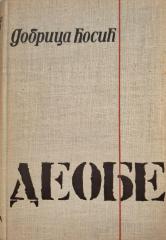
Deobe 1-3

Deobe 1-3

Dobrica Ćosić

This work, awarded the NIN Prize for that year, is considered one of the most significant in Serbian literature after World War II.

Prosveta, 1961.
Serbian. Cyrillic alphabet. Hardcover with dust jacket.
The book consists of 3 volumes
11.42 €
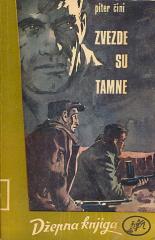
Zvezde su tamne

Zvezde su tamne

Peter Cheyney

"The stars are dark" is a spy thriller by the British writer Peter Cheyney, known for fast, tense stories and hard-boiled characters.

Svjetlost, 1965.
Serbian. Latin alphabet. Paperback.
2.96 €
Gradić gdje je vrijeme stalo

Gradić gdje je vrijeme stalo

Bohumil Hrabal

Bohumil Hrabal, a Czech writer known for his lyrical grotesque and humor, in his novel The Town Where Time Stood Still evokes childhood in the small town of Libeň (part of Prague), where time seems to stand still in a magical but melancholic world.

Hena Com, 2006.
Croatian. Latin alphabet. Paperback.
7.62 €