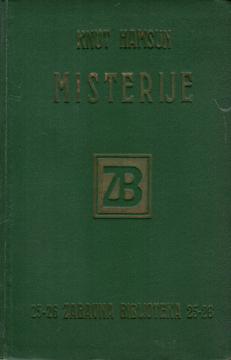
Misterije
Johan Nilsen Nagel arrives in a small Norwegian town and disrupts its quiet atmosphere with his eccentric behavior. Love, loneliness, and inner conflicts gradually lead the enigmatic protagonist toward tragedy.
Mysteries is a psychological novel by the Norwegian writer Knut Hamsun, first published in 1892. At the heart of the work is Johan Nilsen Nagel, a mysterious young man who suddenly arrives in a small Norwegian coastal town. Dressed in a striking yellow suit and carrying a violin case among his luggage, he immediately draws the attention of the locals. Little is known about his past or true intentions, and his actions and statements are often contradictory and unpredictable.
Nagel integrates himself into the life of the town, conversing with its prominent citizens and deliberately challenging their values and beliefs. At the same time, he shows compassion toward Minut, a solitary and humiliated man whom the other residents regard as an eccentric. His interactions with people constantly fluctuate between generosity, provocation, sincerity, and manipulation.
Nagel’s romantic entanglements form a significant part of the novel. He falls in love with Dagny Kielland—who is already engaged—while simultaneously developing a complex relationship with Martha Gude. Unrequited love further deepens his sense of loneliness and inner turmoil.
Hamsun is less interested in a conventional plot than in the consciousness of his protagonist. Through Nagel’s monologues, sudden mood swings, and unusual behavior, he explores the contradictions of the human psyche, alienation, love, jealousy, and the conflict between the individual and society. The boundary between truth and falsehood gradually blurs, leaving Nagel an enigma to both the other characters and the reader. Mysteries is, therefore, primarily a novel about the complexity of human inner nature and the impossibility of fully understanding another person.
One copy is available