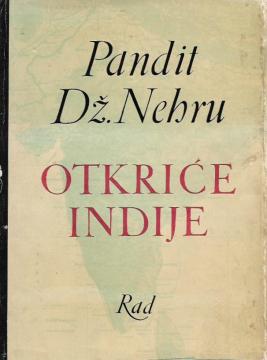
Otkriće Indije

Otkriće Indije

Jawaharlal Nehru

The Discovery of India, written in 1946 during Nehru's time in prison, is a monumental work that explores the history, culture, and spirit of India. Nehru, a key figure in the Indian independence movement, writes about the past and with a vision for the n

Nehru begins his study with ancient Indian civilizations, such as Harappa and the Vedic period, describing the development of religions (Hinduism, Buddhism, Jainism) and their impact on society. Nehru explores Indian philosophy, science, and art, highlighting contributions such as Ayurveda and mathematical discoveries. He moves on to medieval dynasties, including the Mughals, and analyzes their cultural and political influence.

The book also deals with the colonial period, especially British rule, which Nehru criticizes for economic exploitation and social stagnation. He connects the past with the struggle for independence, emphasizing the spirit of resistance and unity of diverse Indian communities. Nehru reflects on Indian identity, emphasizing tolerance and the synthesis of cultures as the strength of the nation.

Through personal anecdotes, such as his time in prison, Nehru reveals his connection to India, but also his concerns for its future. The book ends with an optimistic vision of a modern India that combines tradition with progress. "The Discovery of India" is a profound reflection on the Indian soul, written with erudition and passion.

Original title
The Discovery of India
Translation
Slobodan Petković
Graphics design
Stevan Vujkov
Dimensions
22 x 16 cm
Pages
655
Publisher
Rad, Beograd, 1952.
 
Latin alphabet. Hardcover with dust jacket.
Language: Serbian.

One copy is available

Condition:Used, good condition (visible signs of use)
Damages or inconvenience notice:
  • Damaged book cover
  • Traces of patina
 

Are you interested in another book? You can search the offer using our search engine or browse books by category.

You may also be interested in these titles

Kraj vremena: Revizija proročanstva Maya

Kraj vremena: Revizija proročanstva Maya

Adrian Gilbert

Der britische Autor Adrian Gilbert (Mitautor von „Die Maya-Prophezeiungen“ aus dem Jahr 1995) bietet in „Das Ende der Zeit“ die gründlichste und nüchternste moderne Interpretation des Maya-Kalenders und der sogenannten „Prophezeiung von 2012“ und lehnt di

Stari grad, 2009.
Croatian. Latin alphabet. Hardcover.
18.2214.58 - 18.2414.59
Sloveni u dalekoj prošlosti

Sloveni u dalekoj prošlosti

Valentin V. Sedov

Ein grundlegendes archäologisches und historisches Werk zur Ethnogenese der Slawen vom 2. Jahrtausend v. Chr. bis zur Mitte des 1. Jahrtausends n. Chr. Der Autor rekonstruiert anhand archäologischer Funde die Ursprünge, die Kultur und die frühen Wanderung

Akademska knjiga, 2012.
Serbian. Latin alphabet. Hardcover with dust jacket.
32.00
Neolit i eneolit u Slavoniji

Neolit i eneolit u Slavoniji

Stojan Dimitrijević, Bogdan Brukner, Nikola Tasić, Vladimir Mirosavljević

Der Tagungsband des Symposiums „Neolithikum und Äneolithikum in Slawonien“, das am 4. und 5. Juni 1966 in Vukovar stattfand, vereint Beiträge über neolithische und äneolithische Kulturen, materielle Funde und regionale Verbindungen.

Gradski muzej Vukovar, 1969.
Croatian. Latin alphabet. Paperback with dust jacket.
13.54
Arktička pradomovina Veda

Arktička pradomovina Veda

Bal Gandahar Tilak

Knjiga Arktička pradomovina Veda (1903.) indijskog učenjaka Tilaka iznosi hipotezu da su drevni Arijevci, autori Rigvede, potjecali iz arktičkog područja. Iako kontroverzna, knjiga ostaje važna u proučavanju vedskih tekstova i indijske povijesti.

NIRO Književne novine, 1987.
Serbian. Latin alphabet. Paperback.
17.56
Povijest svijeta: od najstarijeg doba do godine 1940.

Povijest svijeta: od najstarijeg doba do godine 1940.

Marko Vunić
Hrvatsko književno društvo Sv. Jeronima, 1940.
Croatian. Latin alphabet. Hardcover.
9.726.80
Prije faraona: Tajanstvena pretpovijest Egipta

Prije faraona: Tajanstvena pretpovijest Egipta

Edward F. Malkowski

Der amerikanische Forscher Edward Malkowski behauptet in seinem Buch „Before the Pharaohs“, dass die ägyptische Zivilisation die Nachfolgerin einer viel älteren, technologisch fortgeschritteneren Kultur sei, die mindestens 10.000 bis 12.000 Jahre vor der

Stari grad, 2006.
Croatian. Latin alphabet. Hardcover.
16.2412.99 - 16.32