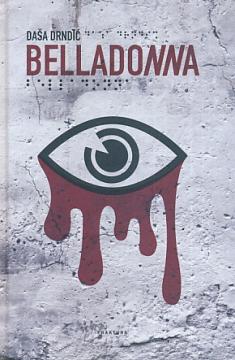
Belladonna

Belladonna

Daša Drndić

Andreas Ban is a writer and psychologist, above all an intellectual full of empathy, but his world has been collapsing for years, and when he retires into a miserable retirement and learns that he is ill, he takes a fresh look at the fragments of his life

In his struggle with illness and old age, Andreas Ban is both cynical and powerful, and while digging through his own past, he encounters stories of the disenfranchised, persecuted, helpless... and in the process uncompromisingly deals with a wide variety of taboos. In Belladonna, Daša Drndić examines and pushes to the extreme the themes of illness and the (im)possibility of living (and dying) in today's, completely dehumanized world and in times when old age and illness are something shameful and when only eternal youth and boundless beauty are propagated. Belladonna is a work in which the real and the fictional, the autobiographical and the invented, are intertwined, and Andreas Ban is a true hero of our time - he is an intellectual rejected by a society that, under the guise of correctness, suppresses the possibility of critical thinking. Daša Drndić was born in Zagreb in 1946. She studied English language and literature at the Faculty of Philology in Belgrade, as a Fulbright scholar she stayed at Southern Illinois University, and then studied at Case Western Reserve University. She worked as an editor at the publishing house "Vuk Karadžić", as an English language teacher at the National University "Đuro Salaj" and as an editor-playwright at Radio-television Belgrade. She received her doctorate at the University of Rijeka, where she taught modern British literature and creative writing at the Department of English. She published prose, literary criticism, analytical texts and translations in magazines and literary magazines, as well as feature and documentary radio dramas.

Editor
Seid Serdarević
Dimensions
23 x 15.5 cm
Pages
311
Publisher
Fraktura, Zaprešić, 2012.
 
Latin alphabet. Hardcover.
Language: Croatian.

One copy is available

Condition:Used, excellent condition
 

Are you interested in another book? You can search the offer using our search engine or browse books by category.

You may also be interested in these titles

Mrtve duše

Mrtve duše

Nikolaj Vasiljevič Gogolj

Dead Souls (1842) is a brilliant satire that exposes the moral and social rot of imperial Russia through Chichikov's fraud with dead serfs, with Gogol's virtuoso mix of humor, irony and lyricism.

Jutarnji list, 2004.
Croatian. Latin alphabet. Paperback.
4.99
Sredina stoljeća

Sredina stoljeća

John Dos Passos
Naprijed, 1965.
Croatian. Latin alphabet. Hardcover with dust jacket.
4.99
Profesor strasti

Profesor strasti

Philip Roth

The novel The Passion Professor (1977) follows the life of David Kepesh, from childhood to his academic career, through the prism of sexual desires and emotional insecurities. Roth's unique style is a mixture of autobiographical elements and satire.

August Cesarec, 1993.
Croatian. Latin alphabet. Paperback.
3.26
Knjiga smijeha i zaborava

Knjiga smijeha i zaborava

Milan Kundera

The novel The Book of Laughter and Forgetfulness (1979), a fragmentary novel in seven parts, explores Czech history under the communist regime, particularly after the 1968 Prague Spring and the Soviet invasion.

Grafički zavod Hrvatske (GZH), 1982.
Croatian. Latin alphabet. Paperback.
9.36
Među svjetlom i tminom

Među svjetlom i tminom

Josip Kozarac
Glas Slavonije, 1974.
Croatian. Latin alphabet. Hardcover.
4.99 - 5.98
Gladno brdo

Gladno brdo

Daphne Du Maurier

Hungry Hill (1943) is a saga of five generations of the Anglo-Irish Brodrick family, owners of Clonmere Castle in Ireland. Du Maurier, a master of Gothic prose, weaves together folklore, curses, and social change, showing how greed destroys heirs.

Nakladni zavod Matice hrvatske, 1977.
Croatian. Latin alphabet. Hardcover with dust jacket.
5.32