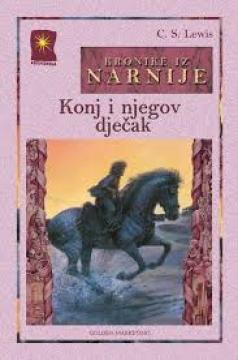
Kronike iz Narnije III: Konj i njegov dječak
Rare book

Kronike iz Narnije III: Konj i njegov dječak

C. S. Lewis

The third installment of the Chronicles of Narnia series by C. S. Lewis. The story takes place in the Golden Age of Narnia, during the reigns of King Peter, Queen Susanna, King Edmund, and Queen Lucy, but mainly in neighboring Calormen and Archenland.

Shasta is a poor boy from a fishing hut in southern Calormene. Raised by a cruel fisherman, he learns that he will be sold as a slave to a wealthy nobleman. One night he escapes and meets Bree – a talking, noble warhorse from Narnia, who has been captured and wants to return home. Shasta and Bree set off north, towards a free Narnia.

In the desert they meet Aravis, a proud Calormene high society girl, and her talking mare Hwin. Aravis is fleeing a forced marriage to the cruel Prince Rabadash, son of the Calormene Sultan. The four travelers (Shasta, Aravis, Bree and Hwin) team up and set off across the desert towards Archenland.

On their journey, Aslan, the great lion, mysteriously guides and protects them: he pushes them forward when they falter, saves them from jackals and lions, and later it turns out that he was both the lion who drove them forward and the one who wounded Aravis earlier (to teach her compassion).

Shasta arrives first in Anvard, the capital of Archenland, and warns King Luna of Rabadash's attack - a Calormene army under Rabadash wants to conquer Archenland and then Narnia. In the great battle of Anvard, the forces of Archenland and Narnia (with Peter, Edmund and the others) are victorious. Rabadash, in a rage, attacks King Luna, but Aslan turns him into a donkey for a year (he later returns to human form, but becomes more cautious and less aggressive).

Shasta discovers that he is actually Cor - the lost twin of Prince Corin, son of King Luna. Kidnapped as a baby and raised in Calormene. He becomes Corin the First, heir to the throne of Archenland. Aravis and Cor later marry and rule wisely and justly.

The book is an allegory of providence, identity, escape from slavery and culture, friendship among different beings, and Aslan's silent but constant protection. It is the most "oriental" and adventurous of all the Chronicles, with an emphasis on courage, repentance, and God's guidance through life's perils.

Original title
The Horse and his Boy
Translation
Pauline Baynes
Editor
Anita Peti-Stantić
Dimensions
21 x 14 cm
Pages
201
Publisher
Golden marketing, Zagreb, 2002.
 
Latin alphabet. Hardcover.
Language: Croatian.
ISBN
978-9-53212-113-1

One copy is available

Condition:Unused
 

Are you interested in another book? You can search the offer using our search engine or browse books by category.

You may also be interested in these titles

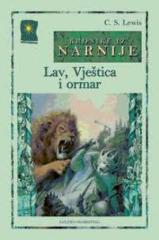
Kronike iz Narnije II: Lav, Vještica i ormar

Kronike iz Narnije II: Lav, Vještica i ormar

C. S. Lewis

Once upon a time there were four children, named Peter, Susan, Edmund and Lucy. This is a story about something that happened to them when they were sent away from London during the war because of air raids.

Golden marketing, 2002.
Croatian. Latin alphabet. Hardcover.
12.32
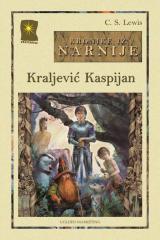
Kronike iz Narnije IV: Kraljević Kaspijan

Kronike iz Narnije IV: Kraljević Kaspijan

C. S. Lewis

Times are tough in Narnia, which is engulfed in civil war. Prince Caspian is forced to send a call for help to the heroes who have already proven themselves in Narnia - Peter, Susan, Edmund and Lucy. They must dethrone Caspian's uncle, King Miraz.

Golden marketing, 2002.
Croatian. Latin alphabet. Hardcover.
12.38
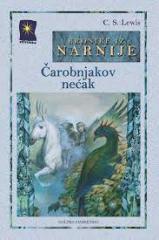
Kronike iz Narnije I: Čarobnjakov nećak

Kronike iz Narnije I: Čarobnjakov nećak

C. S. Lewis

The first part of the Chronicles of Narnia series. C. S. Lewis told the story as a myth of creation, temptation (like Eden), sin, redemption, and the beginnings of Narnia – an allegory of Genesis, the Fall, and God's providence.

Golden marketing, 2001.
Croatian. Latin alphabet. Hardcover.
12.36
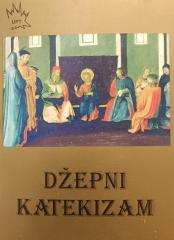
Džepni katekizam za djecu i odrasle

Džepni katekizam za djecu i odrasle

"Pocket Catechism for Children and Adults" is a book translated from French by Srećko Bošnjak and published in 1996 by the Bishop's Ordinariate in Đakovo.

Karitativni fond UPT, 1996.
Croatian. Latin alphabet. Paperback.
1.98
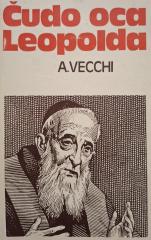
Čudo oca Leopolda

Čudo oca Leopolda

A. Vecchi

The book presents a spiritual and biographical portrait of St. Leopold Bogdan Mandić, a Croatian Capuchin known for his exceptional piety, modesty, and dedicated work in the sacrament of confession.

Kršćanska sadašnjost, 1982.
Croatian. Latin alphabet. Paperback.
3.18
The Message: The Bible in Contemporary Language

The Message: The Bible in Contemporary Language

Eugene H. Peterson

Open The Message and God’s Word Comes Alive! Discover the surprise and wonder of God’s Word. The Message Bible promises to immerse your imagination and stir your faith. Hear God’s heart speaking your heart’s language.

NavPress, 2016.
English. Latin alphabet. Paperback.
9.52