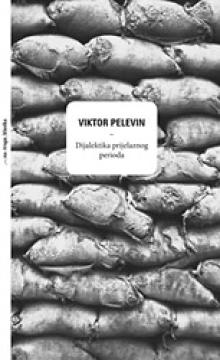
Dijalektika prijelaznog perioda

Dijalektika prijelaznog perioda

Viktor Pelevin

The book represents the author's anthology - the largest part is the novel Čisla (Čisla), followed by the short story Macedonian Criticism of French Thought and several short stories (Odin vog, Akiko, Fokus-grupa, Gost na prazniku bon).

At the heart of Chisla's novel is Stepa (Stepan), an oligarch of the new Russian capitalism of the 90s/2000s. He is obsessed with numbers: his "solar" number 34 (symbol of power, success) clashes with "lunar" 43 (symbol of ruin, Chubais and liberals). Stepa builds his life around the numerological cabal - he chooses numbers for phones, rooms, cars, lovers, jobs - believing that in this way he will control destiny. But the crisis of 1998 and the political turmoil shatter the illusion: the numbers turn against him, leading to paranoia, hallucinations and existential decline.

Pelevin mocks post-Soviet Russia: oligarchs, mafia, politics, Buddhism, New Age, capitalism and spirituality as commodities. Dialectic is a parody of Marxism – the transition from nowhere (Soviet nothingness) to nowhere (the new Russian chaos), where nothing changes, only repeats itself in new forms.

The stories are short, absurd, Buddhist-satirical: about virtual sex, Japanese culture, focus groups and "bon" (Buddhist holiday of the dead). The entire book is a cynical, witty critique of the transition – from communism to capitalism, from the material to the virtual, from nothingness to nothingness – with Pelevin's signature blend of philosophy, pop culture and dark humor.

Original title
Диалектика Переходного Периода из Ниоткуда в Никуда
Translation
Irena Lukšić
Illustrations
Stanko Abadžić
Dimensions
20 x 12.5 cm
Pages
316
Publisher
Disput, Zagreb, 2006.
 
Latin alphabet. Paperback.
Language: Croatian.

One copy is available

Condition:Used, excellent condition
 

Are you interested in another book? You can search the offer using our search engine or browse books by category.

You may also be interested in these titles

Majstor iluzija

Majstor iluzija

Anto Marinčić
Fram Ziral, 2010.
Croatian. Latin alphabet. Hardcover.
4.99
Kartuzijanski manastir u Parmi

Kartuzijanski manastir u Parmi

The novel is about a nobleman and a member of the clergy who chooses love instead of religion.

Branko Đonović, 1964.
Serbian. Latin alphabet. Hardcover.
2.88
Izlet na Kras

Izlet na Kras

Milan Sokić

The trip to the Karst is a small episode in the hero's life, but it perfectly revives the spirit of the turn of the century that is best characterized by Hans Driesch, a scientist, future philosopher, and founder of vitalism.

Fraktura, 2017.
Croatian. Latin alphabet. Hardcover with dust jacket.
6.64
Priča o izgubljenoj djevojčici

Priča o izgubljenoj djevojčici

Elena Ferrante

The finale of a powerful saga about female friendship that became the literary hit of the decade. Ferrante's prose is sharp, intimate - like reading a diary of the soul. It reminds us that friendship is war and peace, and the lost girl within us - the key

Profil Knjiga, 2018.
Croatian. Latin alphabet. Paperback.
14.8611.89
Paralelni svijet

Paralelni svijet

B. D. Benedict

Parallel World is considered Benedikt's boldest and most influential novel, a true pioneering work in which he first publicly presented his "theory of parallel dimensions" which would later become the backbone of his entire oeuvre.

Stari grad, 1997.
Croatian. Latin alphabet. Hardcover.
8.22 - 8.32
Bistri vitez Don Quijote od Manche

Bistri vitez Don Quijote od Manche

Miguel de Cervantes
Globus, 2004.
Croatian. Latin alphabet. Paperback.
The book consists of two volumes
4.22