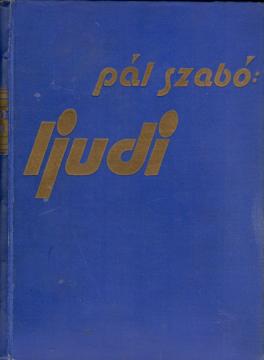
Ljudi
Antique

Ljudi

Pal Szabo

"People" by Pál Szab is a romanticized chronicle of a rural community in which, through everyday life, conflicts, work, and interpersonal relationships, the moral strength, weaknesses, and constant struggle of man for dignity are depicted.

People by Hungarian writer Pál Szabo is a realistic and socially penetrating novel that presents a broad picture of life in a rural community at the turn of the 19th and 20th centuries. The work focuses on ordinary people — peasants, workers, women, young and old — whose lives are marked by hard work, social inequalities, but also a strong sense of community. Szabo depicts the mentality of the rural environment in a classically realistic manner: the struggle for survival, dependence on the land, seasonal rhythms, but also the emotional tensions that arise from close, almost closed coexistence in a small community.

The novel does not have a single central character; instead, the focus is on the entire collective, where individual destinies are intertwined with social changes. In this sense, “People” functions as a kind of panorama of life: it depicts love and jealousies, family disagreements, generational differences, poverty, the pursuit of a better life, and the relationship to tradition. Szabo also highlights the moral dilemmas of the characters, exploring how external circumstances shape human nature and decisions.

The novel's particular value lies in its detailed descriptions of everyday life — from work in the fields to customs, superstitions, and the village as a social organism. The author builds a style that is both simple and poetic, wanting to emphasize that the lives of "little people" are just as worthy of literary depiction as the fates of great heroes.

People is therefore a novel about struggle, endurance, and the moral complexity of ordinary lives, a work that leaves an impression of documentary credibility and deep humanistic empathy for its characters.

Original title
Emberek regény
Translation
Andrija Kovačević
Dimensions
20 x 14 cm
Pages
252
Publisher
Naklada Binoza, Zagreb, 1932.
 
Latin alphabet. Hardcover with dust jacket.
Language: Croatian.

One copy is available

Condition:Used, very good condition
Damages or inconvenience notice:
  • The cover is missing
Discounted price: 5.623.93
30% discount is valid until 6/26/26 11:59 pm
 

Are you interested in another book? You can search the offer using our search engine or browse books by category.

You may also be interested in these titles

Ljubičice u srijedu

Ljubičice u srijedu

Andre Maurois

André Maurois, a French writer known for his psychological novels and biographies, explores themes of family relationships, love, and internal conflicts in this work, which is characteristic of his style.

Svjetlost, 1965.
Croatian. Latin alphabet. Paperback.
3.42 - 3.62
Štefica Cvek u raljama života

Štefica Cvek u raljama života

Dubravka Ugrešić

Do you like "lovelies"? Whatever you think about them, you'll enjoy this superb pastiche of trivial romance novels.

Mladinska knjiga, 1990.
Croatian. Latin alphabet. Hardcover with dust jacket.
4.94
Crna kutija

Crna kutija

Amos Oz

The Black Box is a kaleidoscope of married life and love relationships. It is a novel that implicitly speaks about all of us.

Hena Com, 2001.
Croatian. Latin alphabet. Hardcover.
10.98
Shannonov put

Shannonov put

Archibald Joseph Cronin

Cronin's moving story of redemption. Robert Shannon, a fanatical doctor-researcher, sacrifices love and life for science, but in the end loses everything – his girlfriend, recognition, health – only to realize through suffering: medicine without humanity

Otokar Keršovani, 1966.
Croatian. Latin alphabet. Hardcover with dust jacket.
6.24
Vezana

Vezana

Lauren Henderson

Mistakenly kidnapped and tied to a ceiling beam, Sam Jones tries to remember her special love adventure. The painful blows, along with her innate humor, will encourage the heroine to focus all her peace of mind on solving life's problems.

Škorpion, 2002.
Croatian. Latin alphabet. Hardcover.
7.36
Aurorin poticaj

Aurorin poticaj

Erich Hackl

The work is based on a true event that occurred in Spain in 1933: Aurora Rodriguez killed her daughter Hildegart, a famous fighter for women's emancipation and a cult figure on the political scene of the time.

Mladost, 1990.
Croatian. Latin alphabet. Hardcover with dust jacket.
4.963.74 - 4.984.96