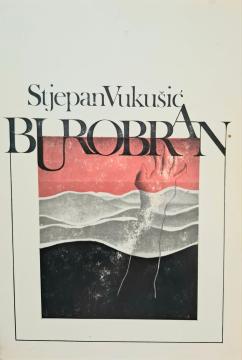
Burobran

Burobran

Stjepan Vukušić

A small collection of 13 short stories and sketches, depicting a neglected region of our time in Croatian literature, which was so comprehensively covered by Croatian writers from the period of realism, and which has no more prominent representatives in o

In such a country, countless social problems do not pass by man, so it is quite understandable that they are also present in Burobran: the struggle for the fruits of the poor land {Burobran), the conflict between the rich and the poor {Rebellion), the path to crime {Thefts), lonely old men without the support of their sons {Farewell), exposure to tuberculosis {Gift), the insatiability of the rich and the empty wombs of the poor {Abandoned to play), leaving the homeland {Foreign Affairs), the education of the poor {Kurir's School), etc., etc. But Vukušić's collection Burobran cannot be said to represent a social story, and putting social problems in the foreground would be forced in retrospect because Vukušić does not experience Podgorje like Novak, nor does he approach problems like our regional realists — his approach to the Podgorje man is specific, he is not interested in what happens to the poor man of the gray rocky land, but how the man experiences the outside world, which experienced in a whirlwind of troubles caused by hunger, poverty and war. The inner world of a small person in a certain environment, the psychological side of life's problems - is the starting and ending point of Vukušić's observations, and the plot, language and composition of Burobrani are subordinated to this image of intimacy.

Editor
Mario Kalčić
Graphics design
Renato Percan
Dimensions
20.5 x 14 cm
Pages
149
Publisher
Glas Istre, Pula, 1976.
 
Latin alphabet. Paperback.
Language: Croatian.

One copy is available

Condition:Used, excellent condition
Discounted price: 8.906.68
25% discount is valid until 8/14/26 11:59 pm
 

Are you interested in another book? You can search the offer using our search engine or browse books by category.

You may also be interested in these titles

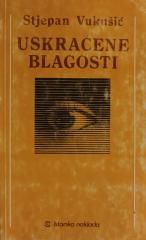
Uskraćene blagosti

Uskraćene blagosti

Stjepan Vukušić
Istarska naklada, 1982.
Croatian. Latin alphabet. Paperback.
3.99
Sikamora

Sikamora

Goran Samardžić

"Sikamura" is a collection that does not offer clear answers, but rather encourages the reader to interpret and reflect, making it demanding but significant in the context of contemporary literature.

Bosanska knjiga, 1997.
Croatian. Latin alphabet. Paperback.
5.98
Sabrana djela A. P. Čehova #1: Humoreske

Sabrana djela A. P. Čehova #1: Humoreske

Anton Pavlovič Čehov

This book includes Chekhov's works from 1880-1885, i.e. humoresques, short stories, and sketches, starting with Letters to a Learned Neighbor, which Chekhov considered the beginning of his literary career.

Zora, 1959.
Croatian. Latin alphabet. Hardcover with dust jacket.
9.54
Prvo šišanje

Prvo šišanje

Bohumil Hrabal

The First Haircut, a short story written in 1970 and published in 1976, is the first in a series of prose pieces by Bohumil Hrabal describing Nymburk, the town where he spent his childhood. In 1981, The First Haircut was adapted for the screen by Jiry Men

24 sata, 2007.
Croatian. Latin alphabet. Paperback.
7.24
Antologija poljske pripovijetke XX stoljeća

Antologija poljske pripovijetke XX stoljeća

Zdravko Malić

The anthology, edited and translated by Zdravko Malić, a leading Croatian Polish scholar and founder of the Polish Language Department at the Faculty of Fine Arts in Zagreb, represents a key selection of Polish short fiction from the 20th century.

Veselin Masleša, 1984.
Croatian. Latin alphabet. Hardcover with dust jacket.
7.24
Gle krasne li paprati

Gle krasne li paprati

Branko Belan

The book "Look How Beautiful the Ferns" by Branko Belan is a collection of short stories set in the Mediterranean milieu, which is characteristic of Belan's literary work.

Alfa, 1978.
Croatian. Latin alphabet. Paperback.
13.26