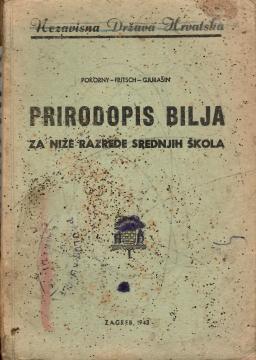
Prirodopis bilja za niže razrede srednjih škola
A botany textbook intended for lower grades of secondary schools in the Independent State of Croatia. Translation and additions to the German original by Alois Pokorny, edited by Karl Fritsch and Stjepan Gjurašin. Richly illustrated with numerous pictures
Natural History of Plants for Lower Secondary School Classes is a popular and long-standing botany textbook that has been used in Croatian schools for decades. It is based on the work of the Austrian author Alois Pokorny (1826–1886), and was adapted for the Croatian edition by the German botanist Karl Fritsch (1864–1934). It was translated and supplemented by the Croatian pedagogue and naturalist Stjepan Gjurašin (1867–1936).
The 1943 edition was published by the Publishing Department of the Croatian State Printing House in Zagreb during the period of the Independent State of Croatia. It is one of the last editions of this long-standing series (previous editions were published since 1915, the 1920s and 1930s).
The book is intended for lower secondary school classes (gymnasiums and realki). It contains a systematic overview of botany adapted to the high school curriculum: plant morphology (structure of roots, stems, leaves, flowers, fruits and seeds), physiology (life functions of plants), the basics of the systematics of the plant kingdom and an overview of the main plant groups (algae, fungi, mosses, ferns, flowering plants). Special attention is paid to practical examples from the local flora.
The textbook is extremely richly illustrated — it contains hundreds of drawings in the text and several colored plates (in some editions up to 48 colored plates), which was its great advantage for students. The illustrations are clear, of pedagogical quality and help in understanding the structure and classification of plants.
The work is written in clear, professional, but accessible Croatian language. It represents the continuity of Croatian natural science terminology developed since the end of the 19th century. Due to its long-term use in schools (from the Austro-Hungarian period through the Kingdom of Yugoslavia to the Independent State of Croatia), it is considered one of the most influential botanical textbooks in Croatian education in the first half of the 20th century.
One copy is available
- Stains on cover