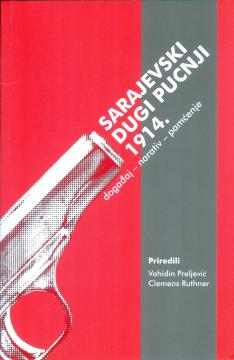
Sarajevski dugi pucnji 1914.: događaj, narativ, pamćenje

Sarajevski dugi pucnji 1914.: događaj, narativ, pamćenje

Sarajevo's Long Shots 1914 is a collection of works, edited by Vahidin Preljević and Clemens Ruthner, based on an international conference held in Sarajevo on the occasion of the centenary of the Sarajevo assassination.

The book was edited by literary scholar Vahidin Preljević and Austrian Germanist Clemens Ruthner. It contains works by about thirty authors from different disciplines (history, literature, cultural studies, anthropology, political science) who approach the assassination and its consequences from multiple perspectives.

The collection explores three key levels:

  • the event itself (historical context, preparation of the assassination, the role of Young Bosnia, immediate circumstances),
  • the narratives that were created around it (in the media, literature, propaganda, different national perspectives),
  • and memory and the culture of remembrance in the 20th and 21st centuries (how the assassination was interpreted in different eras and ideologies, from the Austro-Hungarian era through Yugoslavia to today's divisions).

The special value of the book lies in its attempt to overcome simplified and nationally colored interpretations and in its comparative approach to the European context. It is extensive and represents a significant contribution to contemporary historiography and cultural studies of the region.

Editor
Vahidin Preljević, Clemens Ruthner
Dimensions
23 x 15 cm
Pages
592
Publisher
Vrijeme, Zenica, 2015.
 
Latin alphabet. Paperback.
Language: Croatian.

One copy is available

Condition:Unused
 

Are you interested in another book? You can search the offer using our search engine or browse books by category.

You may also be interested in these titles

Književnost ranog novovjekovlja u Boki Kotorskoj: Hrestomatija za studente

Književnost ranog novovjekovlja u Boki Kotorskoj: Hrestomatija za studente

Viktoria Franić Tomić, Slobodan Prosperov Novak

This student handbook is the most comprehensive presentation to date of the literary heritage of the Bay of Kotor in the early modern period, from the late Renaissance to the Baroque, in which the authors offer a chronological and thematic overview of the

Hrvatska sveučilišna naklada, 2015.
Croatian. Latin alphabet. Paperback.
18.34
Rad JAZU: Knjiga 220 razreda historičko-filologičkoga i filozofičko-juridičkoga

Rad JAZU: Knjiga 220 razreda historičko-filologičkoga i filozofičko-juridičkoga

Vladoje Dukat, Ante Liepopili, Stjepan Zimmermann, Tomo Matić, Marijan Stojković

This issue of the JAZU proceedings brings together works on literary analysis, Slavic liturgy, ontological-noetic issues, and the translation of Pilpaj's fables and Kašić's work.

St. Kugli, 1919.
Croatian. Latin alphabet. Paperback.
9.46
Prikarpatska Galicija: prijevodi s ukrajinskoga

Prikarpatska Galicija: prijevodi s ukrajinskoga

Filozofski fakultet Sveučilišta u Zagrebu, 2017.
Croatian. Latin alphabet. Paperback.
14.76
Liburnijske teme 8: Brseč i Brešćina

Liburnijske teme 8: Brseč i Brešćina

"Liburnian Topics" represent a valuable serial publication (proceedings) initiated by the Chair of the Čakavian Parliament in Opatija with the aim of researching and preserving the historical, cultural and natural heritage of the Liburnian region.

Čakavski sabor, 1994.
Croatian. Latin alphabet. Paperback.
12.36
O duhu otvorenosti: dimenzije misaonog nasleđa Radomira Konstantinovića

O duhu otvorenosti: dimenzije misaonog nasleđa Radomira Konstantinovića

The collection is an important contribution to the revitalization of Konstantinović's thought in the post-Yugoslav space, demonstrating that his critique of the rural mind remains relevant for understanding contemporary social and political pathologies.

Gradska biblioteka Subotica, 2016.
Serbian. Latin alphabet. Paperback.
7.32
Ukrajinski Karpati: Etnogeneza, arheologija, etnologija

Ukrajinski Karpati: Etnogeneza, arheologija, etnologija

The collection is an interdisciplinary bridge between Ukrainian and Croatian science, encouraging comparative research on Slavic migrations. It presents the Carpathians as a "living archipelago" connecting East and West, important for Croatian ethnogenesi

Filozofski fakultet Sveučilišta u Zagrebu, 2014.
Croatian. Latin alphabet. Paperback.
18.34