Kirke: Roman Marije Tarnovske
Antique
Rare book

Kirke: Roman Marije Tarnovske

Annie Vivanti

Kirke Annie Vivanti is a novel inspired by the life of Marija Tarnowska. The Croatian edition from 1918, translated by Olga and Tonči Filipić, is interesting today primarily as a rare edition by the Jug Publishing House.

Circe, a novel by the famous writer Annie Vivanti, was published in Croatian in 1918 in Zagreb by the Jug Publishing House, translated by Olga and Tonči Filipić. The work is inspired by the real life of Maria Tarnowska, one of the most famous European social and judicial sensations of the early 20th century, and the author shapes her story into a psychological and social novel.

For the Croatian cultural and bibliographical heritage, the book is particularly interesting as an early edition by the Jug Publishing House, one of the most important Croatian publishers immediately after the end of World War I. Such editions are relatively rare on the market today, especially when preserved in their original soft covers.

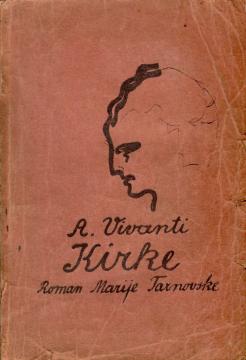
The cover is adorned with a characteristic Art Nouveau drawing of a female profile, which visually emphasizes the motif of a fatal woman and symbolically refers to the ancient Circe after whom the novel was named. The work thus represents an interesting blend of European popular literature, real historical events, and Croatian publishing production from the early 20th century, and is valuable today primarily as a rare bibliographic and collector's item.

Original title
Circe - Il romanzo di Maria Tarnowska
Translation
Olga Filipić, Tonči Filipić
Editor
Stjepan Cihlar
Dimensions
18.5 x 12.5 cm
Pages
215
Publisher
Nakladni zavod Jug, Zagreb, 1918.
 
Latin alphabet. Paperback.
Language: Croatian.

One copy is available

The copy is relatively well preserved, except that it is missing the back cover.
Condition:Used, good condition (visible signs of use)
 

Are you interested in another book? You can search the offer using our search engine or browse books by category.

You may also be interested in these titles

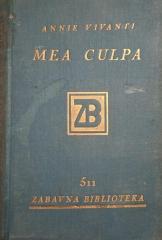
Mea culpa

Mea culpa

Annie Vivanti

In the novel "Mea Culpa", about the love of a young Englishwoman for two men, an English officer and an Egyptian nobleman and fighter for national rights, which she wrote at the beginning of the twentieth century.

Narodne novine, 1931.
Croatian. Latin alphabet. Hardcover.
7.98
Radovi na krovu: sedam džepnih krimića

Radovi na krovu: sedam džepnih krimića

Pavao Pavličić

Seven short, independent stories in the "pocket crime novel" format by the master of Croatian crime fiction: fast, tense, concise, with unexpected twists and Pavličić's typical blend of everyday life and crime.

Narodna knjiga, 1984.
Croatian. Latin alphabet. Paperback.
4.26
Bosna i Hercegovina: Opisana i ocrtana

Bosna i Hercegovina: Opisana i ocrtana

Rudolf Maldini-Wildenhainski

Rudolf Baron Maldini Wildenhainski vividly describes the natural beauties, landscapes, old towns and customs of Bosnia and Herzegovina at the beginning of the 20th century. Bibliophile edition on kunstdruck paper with 136 images.

Hrvatsko planinarsko društvo, 1909.
Croatian. Latin alphabet. Hardcover.
127.56
Isus – čovjek koji živi

Isus – čovjek koji živi

Malcolm Muggeridge

A spiritual classic of the 20th century, one of the most famous and influential contemporary biographies of Jesus Christ, written by British convert, journalist, satirist, and television star Malcolm Muggeridge.

Kršćanska sadašnjost, 1983.
Croatian. Latin alphabet. Paperback with dust jacket.
18.36
Osvit: Slike iz tridesetih godina

Osvit: Slike iz tridesetih godina

Ksaver Šandor Gjalski

A historical novel about the Croatian national revival (Illyrianism) in the 1830s. Gjalski's first significant work of historical prose, a realistic-romantic depiction of the awakening of national consciousness.

Matica hrvatska, 1892.
Croatian. Latin alphabet. Hardcover.
6.32
Na starim ognjištima

Na starim ognjištima

Aleksa Šantić

A collection of patriotic and patriotic poems by Aleksa Šantić (Mostar, 1913) inspired by the Balkan Wars of 1912–1913. One of Šantić's most famous collections, it expresses national enthusiasm and longing for liberation.

Knjižarnica Trifka Dudića, 1913.
Serbian. Cyrillic alphabet. Paperback.
24.32