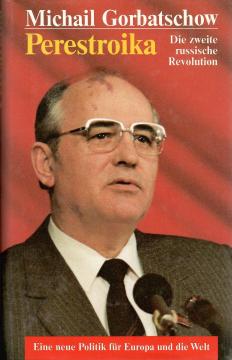
Perestroika: Die zweite russische Revolution - Eine neue Politik für Europa und die Welt
In the book, Mikhail Gorbachev explains perestroika as the second Russian revolution – a reform of Soviet society, economy and international politics. He advocates openness (glasnost), democracy and new cooperation with the West.
Perestroika: The Second Russian Revolution – A New Policy for Europe and the World is a programmatic book by Mikhail Gorbachev, the then General Secretary of the CPSU. It was published at a time when his reforms were in full swing and represents the official vision of changes in the Soviet Union and the world. The book became an international bestseller and an important document of the end of the Cold War.
Gorbachev presents perestroika (restructuring) as a necessary second Russian revolution that should overcome the stagnation of the Brezhnev era. He criticizes bureaucracy, corruption and the inefficiency of the planned economy and advocates the introduction of elements of a market economy: the independence of enterprises, limited private initiative and a greater role for science and technology. At the same time, he emphasizes that perestroika is not an abandonment of socialism, but its improvement – socialism with a human face.
Along with economic reform, glasnost (openness) – freedom of speech, transparency and democracy within the party and society – takes center stage. Gorbachev believes that without public discussion and criticism there is no real progress. The book also deals with international politics: new thinking (new thinking) rejects Cold War confrontation and advocates world interdependence, disarmament, cooperation with the West and solving global problems (ecology, poverty). Gorbachev sees Europe and the world as a unique space where socialism and capitalism can peacefully coexist and learn from each other.
The style of the book is clear, convincing and optimistic. Gorbachev writes as a visionary and pragmatist who wants the West to understand him, but also as a faithful Marxist-Leninist who believes in the restoration of socialism. The book contains personal reflections, historical analyzes and specific proposals for reforms.
Today, perestroika and glasnost are seen as key processes that led to the fall of the Berlin Wall, the end of the Cold War, and the collapse of the USSR in 1991—outcomes that Gorbachev did not want but that his reforms indirectly made possible. The book remains an important historical document: a testimony to the hopes, illusions and tragedy of the last attempt to reform the Soviet system. It is valuable to readers because it shows first-hand the inner logic of Gorbachev's policies—a mixture of idealism, pragmatism, and the limitations of the system he tried to change.
One copy is available