Gruppenbild mit Dame
The novel reconstructs the life of Leni Pfeiffer through testimonies and documents. Leni survives Nazism, war and the post-war period, falls in love with a Soviet prisoner and remains true to her humanity despite everything.
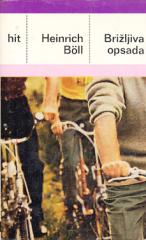
Group Picture with a Lady (1971) is one of Heinrich Böll's most important novels and a work that significantly contributed to the awarding of the Nobel Prize for Literature in 1972. The novel is a pseudo-documentary reconstruction of the life of an ordinary woman – Leni Pfeiffer (née Gruyten) – in 20th-century Germany, from the Weimar Republic through Nazism, war and the post-war period to the early 1970s.
The story is told through the perspective of an anonymous “Verf.” (compiler), who, like an investigator or journalist, collects testimonies, documents, gossip and memories from numerous people who knew Leni. This mosaic of voices creates a layered, polyphonic picture of an era and its heroine. Leni is an intelligent but uneducated, simple and extremely well-intentioned woman who refuses to conform to the prevailing norms. During the war, she works in a flower shop, falls in love with a Soviet prisoner of war Boris Koltovsky, gives birth to his child and is therefore branded as a blue Soviet whore. Her love for the "enemy" becomes a symbol of resistance to dehumanization.
The novel is rich in a gallery of characters: from Lenin's family (who initially profit from Nazism), through neighbors, colleagues, priests, to the Turkish guest worker Mehmet in the post-war period. Böll masterfully depicts how ordinary people survive history – through opportunism, fear, suffering, but also silent resistance. The criticism of German society is particularly strong: Nazism, war madness (especially the bombing of Cologne), post-war conservatism and an economic miracle that forgets humanity.
The style is typically Böll's: ironic, humane, sometimes sarcastic, with elements of the grotesque and satire. The novel combines realism, documentary and lyrical vision (e.g. the figure of the nun Rahel, inspired by Edith Stein). Böll does not judge the characters morally, but shows them in their multifaceted nature – even the “bad guys” have human traits. The central message is humanism: Leni embodies simple goodness and resistance to all forms of exclusion, racism and ideology.
Group picture with a lady is considered Böll’s epic sum – a synthesis of his themes (war, Catholicism, the German past, solidarity with the marginalized). Critics praised it as great literature, although some (e.g. Reich-Ranicki) criticized the formal “messiness”. The book was adapted into a film in 1977 with Romy Schneider in the lead role.
Jedan primerak je u ponudi