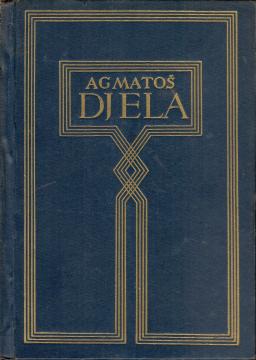
Djela 8: Oko Zagreba i po Hrvatskoj
The eighth volume of Matoš's Works, edited by Julije Benešić, is a collection of feuilletons, travelogues and impressions of Zagreb, its surroundings and Croatian regions, full of lyrical landscapes, social criticism and polemical observations.
Matoš's literary legacy was collected by Milan Matoš, and for this volume the editorial baton was taken over by Julije Benešić (after Antun Barac had edited most of the previous volumes). The texts are arranged with philological responsibility, with notes on previous publications. The collection brings together Matoš's feuilletons, travelogues and impressions dedicated to Zagreb and various Croatian regions.
Matoš writes as a passionate walker and observer — his texts combine vivid descriptions of landscapes, portraits of people, customs and sharp social criticism. Landscapes are not just decor — they become symbols of the spiritual state of the people, nostalgia or criticism of modernity.
The style is typically Matoš's: impressive, lyrical and polemical. He loves Zagreb (although he often criticizes it), describes its streets, parks, surrounding villages and people with warmth, but also irony. The texts contain autobiographical elements — Matoš, as a returnee from emigration, observes his homeland with a mixture of love, disappointment and hope. He criticizes the petty bourgeoisie, political circumstances, provincialism and moral decadence, while at the same time celebrating natural beauty and national values.
This collection builds on Naše ljude i krajve and Dojmove, but is more “domestic” and topographically specific. It shows Matoš as an excellent travel writer and feuilletonist who enriched Croatian literature with a modern, subjective approach to landscape and social chronicle. In the context of the collected works, the eighth volume emphasizes Matoš’s roots in his homeland despite his cosmopolitan spirit.
Benešić’s edition made these texts part of the canon. Today, Oko Zagreba i po Hrvatskoj is read as a precious document about Croatia from the beginning of the 20th century — a vivid picture of regions, mentalities and problems that are still recognizable today. The collection highlights Matoš's love for his native land, his wanderlust, and his ability to transform an ordinary scene into an artistic experience. It is essential for understanding Matoš's entire oeuvre and his relationship to his homeland.
One copy is available
- Slight damage to the cover