Zvonar crkve Notre-Dame

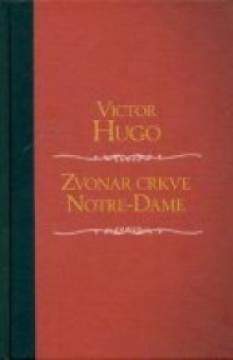
Zvonar crkve Notre-Dame
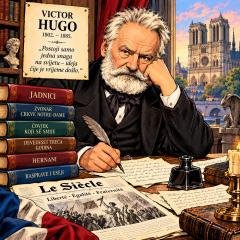
Victor Hugo

Hugo's novel about medieval Paris at the end of the 15th century, written in the spirit of Romanticism. It is a novel of human passions, a novel about three unhappy loves, but above all it is an epic about the Cathedral as the "main character" and represe

The main characters include Quasimodo, a hunchbacked bell ringer of the cathedral, who is devoted to his patron, Archdeacon Claude Frollo. Quasimodo, despite his deformity and social outcast, possesses a noble heart. Frollo, obsessed with lust for the beautiful gypsy Esmeralda, sinks into moral and spiritual chaos. Esmeralda, a noble but naive dancer, attracts the attention of Frollo, Quasimodo, and the young captain Phoebus, who is selfish and unfaithful. The plot is complicated when Frollo, overcome with jealousy, tries to destroy Esmeralda, accusing her of witchcraft after she rejects his love.

Quasimodo, in love with Esmeralda for her kindness, tries to protect her by hiding her in the cathedral. However, Esmeralda's love for Phoebus and Frollo's betrayal lead to a tragic end: Esmeralda is executed, and Quasimodo, in despair, kills Frollo and dies next to Esmeralda's body. The novel explores themes of love, sacrifice, social injustice, and the conflict between passion and duty.

Hugo masterfully depicts medieval Paris, criticizing the hypocrisy of the church and society. Notre-Dame Cathedral symbolizes eternity amidst human frailties. The work, filled with emotion and drama, remains a classic of world literature.

Original title
Notre-Dame de Paris, 1831.
Translation
Ivan Šubarić
Graphics design
Halid Malla
Dimensions
20.5 x 13.5 cm
Pages
495
Publisher
Jutarnji list, Zagreb, 2005.
 
Latin alphabet. Hardcover.
Language: Croatian.
ISBN
978-9-53716-087-6

One copy is available

Condition:Unused
 

Are you interested in another book? You can search the offer using our search engine or browse books by category.

You may also be interested in these titles

Kozeta

Kozeta

Victor Hugo

Cosette is a fictional character in the 1862 novel Les Misérables by Victor Hugo and in many adaptations of the story for stage, film, and television. Her birth name, Euphrasie, is mentioned only briefly.

Školska knjiga, 1982.
Croatian. Latin alphabet. Paperback.
2.45
Cosette, Gavroche

Cosette, Gavroche

Victor Hugo
Mladost, 1971.
Croatian. Latin alphabet. Hardcover.
6.22 - 6.64
Očevi i djeca

Očevi i djeca

Ivan S. Turgenjev

The novel explores the clash of generations and ideologies in 19th-century Russia, focusing on the conflict between traditionalism and nihilism. Set in rural Russia, the work follows the fates of young intellectuals and their relationships with their fami

Globus, 2005.
Croatian. Latin alphabet. Hardcover.
5.46
Germinal

Germinal

Émile Zola

A novel that represents the pinnacle of literary creation by one of the most significant representatives of naturalism in literature.

Jutarnji list, 2004.
Croatian. Latin alphabet. Hardcover.
3.26 - 5.34
Komedije: Ukroćena goropadnica / Mnogo vike ni za što / Na Tri kralja ili Kako hoćete / Sve je dobro što se dobro svrši

Komedije: Ukroćena goropadnica / Mnogo vike ni za što / Na Tri kralja ili Kako hoćete / Sve je dobro što se dobro svrši

William Shakespeare

The Taming of the Shrew, Much Ado About Nothing, Three Kings Day or As You Like It, and All's Well That Ends Well - are masterpieces by the English playwright, known for his wit, romantic plots, and exploration of human relationships.

Globus, 2004.
Croatian. Latin alphabet. Hardcover.
5.243.96 - 5.36
Izabrane komedije: Tartuffe / Mizantrop

Izabrane komedije: Tartuffe / Mizantrop

Jean-Baptiste Poquelin Molière

Tartuffe is Molière's typical Plautian comedy, written in 1664, when it was first performed. The Misanthrope or Irritable Lover is a comedy of manners, first performed on June 4, 1666, at the Théâtre du Palais-Royal in Paris.

Globus, 2005.
Croatian. Latin alphabet. Hardcover.
6.82 - 7.32