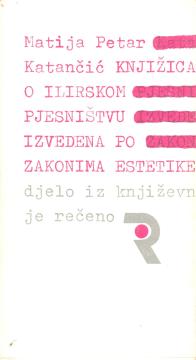
Knjižica o ilirskom pjesništvu izvedena po zakonima estetike

Knjižica o ilirskom pjesništvu izvedena po zakonima estetike

Matija Petar Katančić

Katančić's theoretical work from 1788 is the first systematic aesthetic study of Croatian literature. Based on ancient models and folk tradition, he establishes the normative rules of Illyrian poetry.

Booklet on Illyrian poetry performed according to the laws of aesthetics (De poesi Illyrica ad leges aestheticae exactis libellus, 1788) by the famous Slavonian Franciscan, polyhistorian and translator Matija Petar Katančić represents the fundamental work of Croatian poetics and literary theory of the 18th century. Created in the spirit of the Enlightenment and classicism, this Latin writing brings the first systematic application of ancient normative aesthetic principles to poetry written in the Croatian (Illyrian) language.

Katančić approaches literary creativity in an extremely erudite way: he analyzes metrics, rhythm and stylistic figures, trying to prove that the Illyrian language is completely equal to classical Latin and ancient Greek in terms of its flexibility, richness and melodiousness. The work is divided into theoretical elaborations of aesthetic rules and analytical examples, where the author pays special attention to folk songs and the tradition of Dubrovnik and Dalmatian Renaissance and Baroque literature.

By emphasizing the common language and cultural heritage, Katančić lays the early theoretical and conceptual foundations for the later Croatian national revival with this booklet, which is why this work occupies a key place in the history of Croatian aesthetics and philology.

Original title
De poesi Illyrica ad leges aestheticae exactis libellus
Translation
Stjepan Sršan
Editor
Stjepan Sršan, Stanislav Marijanović
Dimensions
20 x 12 cm
Pages
232
Publisher
Izdavački centar Revija, Osijek, 1974.
 
Latin alphabet. Paperback.
Language: Croatian.

One copy is available

Condition:Used, excellent condition
 

Are you interested in another book? You can search the offer using our search engine or browse books by category.

You may also be interested in these titles

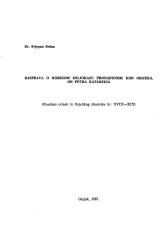
Rasprava o rimskom miljokazu pronađenom kod Osijeka

Rasprava o rimskom miljokazu pronađenom kod Osijeka

Matija Petar Katančić

In his study from 1782, Petar Katančić scientifically examines a Roman milestone found near Osijek (Mursa), making a pioneering contribution to the ancient archaeology of Slavonia and Pannonia.

Muzej Slavonije, 1987.
Croatian. Latin alphabet. Paperback.
14.46
Moj zagrebački rukopis

Moj zagrebački rukopis

Zvonimir Milčec

Milčec is still just as in love with the city. He conquers it just as youthfully. The siege of Zagreb has made no one smaller. The city grows and the conqueror continues to conquer the unconquerable.

VBZ, 2007.
Croatian. Latin alphabet. Hardcover.
14.98
Liga ribara

Liga ribara

Marija Andrijašević

The League of Fishermen brings together everything that makes us read Marija Andrijašević: complex characters, flexible and sumptuous language, convincing dialogues and stories that will hook you with discreet humor.

Oceanmore, 2024.
Croatian. Latin alphabet. Paperback.
11.988.99
Sve ča mi rabi ovega prolića

Sve ča mi rabi ovega prolića

Evelin Rudan

Everything I Need This Spring is the first solo poetry collection by Evelina Rudan, a poet and scholar from Pula and Zagreb (born 1971). The book represents a significant contribution to contemporary Istrian Chakavian lyric poetry.

Naklada MD, 2000.
Croatian. Latin alphabet. Paperback.
5.323.72
U rovovima interpretacija: Strategija i tragedija nelegitimnog čitanja

U rovovima interpretacija: Strategija i tragedija nelegitimnog čitanja

Nebojša Lujanović

The book by Split writer and political scientist Nebojša Lujanović (born 1981 in Novi Travnik) is an intriguing polemic against the ideological abuses of Ivo Andrić, especially the nationalistic readings of his work from the Bosnian, Serbian and Croatian

V.B.Z, 2020.
Croatian. Latin alphabet. Hardcover.
13.44
Kuća u kojoj stanuje vrag

Kuća u kojoj stanuje vrag

Goran Tribuson

In The House Where the Devil Dwells, Tribuson also thematizes the time of new poverty, crazy jokes on the way to earning money, usury, jealousy, revenge, strikes, and murders.

Znanje, 2006.
Croatian. Latin alphabet. Paperback.
7.87