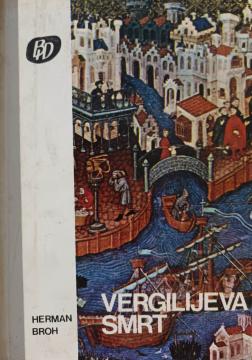
Vergilijeva smrt

Vergilijeva smrt

Hermann Broch

The Death of Virgil (1945) is Hermann Broch's most famous work. The novel follows the final days of the Roman poet Publius Virgilius Marus, who, gravely ill, travels from Athens to Brundisium, arriving on the birthday of Emperor Augustus in 19 AD.

The action takes place in the last eighteen hours of Virgil's life, gripped by fever and a foreboding of death. The novel is divided into four chapters, each corresponding to a part of the day: the arrival by ship, a walk through the slums, a conversation with the emperor Augustus, and the final death.

Virgil, gravely ill with melancholy, lies on a stretcher in the midst of a mass of passengers, symbols of chaos and transience. The doctor Charondas sees the illness as a creative force. In the palace, through the stream of consciousness – "the only lyric poem" – the poet despairs: the Aeneid is not authentic art, but a compromise with the imperial ideology. He wants to destroy the manuscript, but Augustus dissuades him, emphasizing its role in stabilizing the Empire.

The philosophical dialogue with the emperor reveals a dualism: art seeks truth and the transcendent, power – order and falsehood. Broch explores the existential crisis of the artist in a transitional age (pagan to Christian), melancholy as a path to enlightenment, and the conflict between the titanic and the Dionysian.

On his deathbed, a vision of a mother and child – a prefiguration of Christianity – frees Virgil. He dies in ecstasy, accepting death. The hybrid genre – historical novel, lyric poem – is dense with symbols, inspired by Joyce. It projects Broch's crisis in exile: the search for meaning amidst chaos. A challenging, profound work about authenticity and the ethics of creativity.

Original title
Der tod des Vergil
Translation
Vera Stojić
Editor
Todor Dutina
Dimensions
20 x 14 cm
Pages
451
Publisher
Svjetlost, Sarajevo, 1982.
 
Distribution: 8,000 copies
 
Latin alphabet. Hardcover.
Language: Croatian.

One copy is available

Condition:Used, very good condition
Damages or inconvenience notice:
  • Traces of patina
  • Signature of previous owner
 

Are you interested in another book? You can search the offer using our search engine or browse books by category.

You may also be interested in these titles

O čemu ne govorimo

O čemu ne govorimo

Slavenka Drakulić

Can you face the taboos of modern society? Old age, illness, weakness. Slavenka Drakulić bravely enters into topics we are reluctant to talk about.

Fraktura, 2024.
Croatian. Latin alphabet. Hardcover with dust jacket.
14.62
Adio kauboju

Adio kauboju

Olja Savičević Ivančević

The novel itself is conceptually carried by a lucid comparison of Dalmatia and the Wild West: on a thematic level, cowboys are the mythical place of the childhood of the main character and her brother.

Algoritam, 2010.
Croatian. Latin alphabet. Hardcover.
8.82
Zastava od prašine

Zastava od prašine

Lana Derkač

Lana Derkač's prose is one of those rare exceptions that does not agree to race on readership charts and adapt to the laws of market logic, exceptions in which subtlety and reflection take precedence over fabularization and flirting with readers.

VBZ, 2009.
Croatian. Latin alphabet. Hardcover.
7.22
Šangri-la

Šangri-la

Krunoslav Mikulan

In the novel, the author describes and comments on domestic socio-political phenomena with dark humor and criticism, almost vaudeville-like, while using a good deal of lively and juicy Međimurje speech.

Naklada Ljevak, 2024.
Croatian. Latin alphabet. Hardcover with dust jacket.
14.95
Provincijalac

Provincijalac

Momo Kapor

As much as Foliranti is a story about Kapor's student days in Belgrade in the late fifties, Provincial is a book that evokes memories of his childhood in Sarajevo, where the author spent the first years of his life.

Znanje, 1984.
Serbian. Latin alphabet. Paperback.
5.323.99
Američko-hrvatski u boji – dio prvi – Marija i zvijer

Američko-hrvatski u boji – dio prvi – Marija i zvijer

Dejan Šorak

The saga of Dejan Šork's film "American-Croatian in Color" in its second part, "Venice of Death," follows the life of director Desdemona Marin, the fourth generation of a Croatian immigrant family connected by fate to film.

Algoritam, 2008.
Croatian. Latin alphabet. Hardcover.
5.98