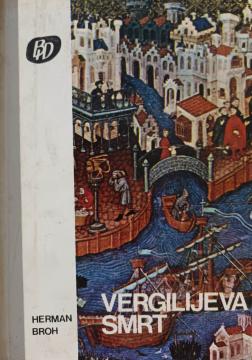
Vergilijeva smrt

Vergilijeva smrt

Hermann Broch

The Death of Virgil (1945) is Hermann Broch's most famous work. The novel follows the final days of the Roman poet Publius Virgilius Marus, who, gravely ill, travels from Athens to Brundisium, arriving on the birthday of Emperor Augustus in 19 AD.

The action takes place in the last eighteen hours of Virgil's life, gripped by fever and a foreboding of death. The novel is divided into four chapters, each corresponding to a part of the day: the arrival by ship, a walk through the slums, a conversation with the emperor Augustus, and the final death.

Virgil, gravely ill with melancholy, lies on a stretcher in the midst of a mass of passengers, symbols of chaos and transience. The doctor Charondas sees the illness as a creative force. In the palace, through the stream of consciousness – "the only lyric poem" – the poet despairs: the Aeneid is not authentic art, but a compromise with the imperial ideology. He wants to destroy the manuscript, but Augustus dissuades him, emphasizing its role in stabilizing the Empire.

The philosophical dialogue with the emperor reveals a dualism: art seeks truth and the transcendent, power – order and falsehood. Broch explores the existential crisis of the artist in a transitional age (pagan to Christian), melancholy as a path to enlightenment, and the conflict between the titanic and the Dionysian.

On his deathbed, a vision of a mother and child – a prefiguration of Christianity – frees Virgil. He dies in ecstasy, accepting death. The hybrid genre – historical novel, lyric poem – is dense with symbols, inspired by Joyce. It projects Broch's crisis in exile: the search for meaning amidst chaos. A challenging, profound work about authenticity and the ethics of creativity.

Naslov originala
Der tod des Vergil
Prevod
Vera Stojić
Urednik
Todor Dutina
Dimenzije
20 x 14 cm
Broj strana
451
Izdavač
Svjetlost, Sarajevo, 1982.
 
Tiraž: 8.000 primeraka
 
Latinica. Tvrde korice.
Jezik: Hrvatski.

Jedan primerak je u ponudi

Stanje:Korišćeno, u vrlo dobrom stanju
Oštećenja / nepogodnosti:
  • Signature of previous owner
  • Traces of patina
Dodato u korpu!
 

Zanima Vas i neka druga knjiga? Možete pretražiti našu ponudu pomoću pretrage ili prelistati knjige po kategorijama.

Možda će Vas zanimati i ovi naslovi

Najljepše priče klasične starine 1-2

Najljepše priče klasične starine 1-2

Gustav Schwab

Schwab's work renews and develops a sense of the value of antiquity, that inexhaustible source of folk fantasy that seeks to interpret and explain the world with original poetic power.

CID-NOVA, 1995.
Hrvatski. Latinica. Tvrde korice.
Knjiga se sastoji od dva toma
19,42
Josip i njegova braća II: Mladi Josip

Josip i njegova braća II: Mladi Josip

Thomas Mann

The second part of the tetralogy by German Nobel Prize winner Thomas Mann, Joseph and His Brothers, is entitled Young Joseph. This tetralogy is considered one of the most important works by Thomas Mann, as well as by German literature of the twentieth cen

Fraktura, 2009.
Hrvatski. Latinica. Tvrde korice s omotom.
27,34
Izabrane pjesme / Ausgewählte Gedichte

Izabrane pjesme / Ausgewählte Gedichte

Johann Wolfgang Goethe

A representative selection from the lyrics of Goethe, one of the greatest European poets, encompassing key phases of his work – from Sturm und Drang, through the classical Weimar period to his late poems.

Matica hrvatska, 2012.
Hrvatski. Latinica. Broširano.
5,32
Pljačkaši prirode

Pljačkaši prirode

Thomas Daring

Knjiga Thomasa Daringa (pseud. Antona Zischke) koja se fokusira na temu kolonijalne eksploatacije prirodnih bogatstava tokom 19. i 20. stoljeća. Vrlo rijetko u ponudi s lijepo očuvanim ovitkom.

Naklada Binoza, 1939.
Hrvatski. Latinica. Tvrde korice s omotom.
23,48
Sanjaj nemogući san

Sanjaj nemogući san

Johannes Mario Simmel

Knjiga autora bestselera „Jimmy i duga“, roman je koji spaja ljubavnu priču s uzbudljivim događajima na pozadini rata u Bosni. Ova priča, prepletena povijesnim kontekstom, podsjeća da je nemogući san ponekad jedini vrijedan snivanja.

Mozaik knjiga, 1997.
Hrvatski. Latinica. Tvrde korice.
7,42
Homo faber

Homo faber

Max Frisch

Homo Faber Maxa Frischa jedna je od najvažnijih i najčitanijih knjiga 20. stoljeća: inženjer Walter Faber vjeruje u svoj racionalni pogled na svijet koji je trajno razoren 'ljubavnom pričom'.

Bratstvo-Jedinstvo, 1962.
Srpski. Latinica. Tvrde korice.
3,16