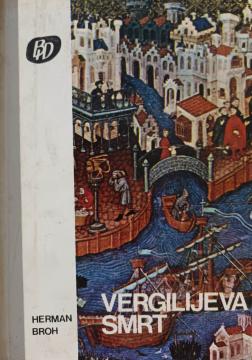
Vergilijeva smrt

Vergilijeva smrt

Hermann Broch

The Death of Virgil (1945) is Hermann Broch's most famous work. The novel follows the final days of the Roman poet Publius Virgilius Marus, who, gravely ill, travels from Athens to Brundisium, arriving on the birthday of Emperor Augustus in 19 AD.

The action takes place in the last eighteen hours of Virgil's life, gripped by fever and a foreboding of death. The novel is divided into four chapters, each corresponding to a part of the day: the arrival by ship, a walk through the slums, a conversation with the emperor Augustus, and the final death.

Virgil, gravely ill with melancholy, lies on a stretcher in the midst of a mass of passengers, symbols of chaos and transience. The doctor Charondas sees the illness as a creative force. In the palace, through the stream of consciousness – "the only lyric poem" – the poet despairs: the Aeneid is not authentic art, but a compromise with the imperial ideology. He wants to destroy the manuscript, but Augustus dissuades him, emphasizing its role in stabilizing the Empire.

The philosophical dialogue with the emperor reveals a dualism: art seeks truth and the transcendent, power – order and falsehood. Broch explores the existential crisis of the artist in a transitional age (pagan to Christian), melancholy as a path to enlightenment, and the conflict between the titanic and the Dionysian.

On his deathbed, a vision of a mother and child – a prefiguration of Christianity – frees Virgil. He dies in ecstasy, accepting death. The hybrid genre – historical novel, lyric poem – is dense with symbols, inspired by Joyce. It projects Broch's crisis in exile: the search for meaning amidst chaos. A challenging, profound work about authenticity and the ethics of creativity.

Original title
Der tod des Vergil
Translation
Vera Stojić
Editor
Todor Dutina
Dimensions
20 x 14 cm
Pages
451
Publisher
Svjetlost, Sarajevo, 1982.
 
Distribution: 8,000 copies
 
Latin alphabet. Hardcover.
Language: Croatian.

One copy is available

Condition:Used, very good condition
Damages or inconvenience notice:
  • Signature of previous owner
  • Traces of patina
 

Are you interested in another book? You can search the offer using our search engine or browse books by category.

You may also be interested in these titles

Karlo i XX. stoljeće

Karlo i XX. stoljeće

Rudolf Brunngraber

Priča o Karlu Lakneru, uhvaćenom u ogromni svjetski stroj kapitalizma. Politički i ekonomski vizionarski roman Rudolfa Brunngrabera iz 1930-ih godina.

Naklada Binoza, 1939.
Croatian. Latin alphabet. Hardcover with dust jacket.
9.56 - 37.42
Hura, još živimo

Hura, još živimo

Johannes M. Simmel

Roman prati život Jakoba Formanna od 1946. do 1976.: od siromašnog povratnika iz rata, preko poslovnih uspona, ljubavi, brakova i skandala, do postajanja jednim od najbogatijih i najpoznatijih ljudi u Njemačkoj.

Mladost, 1980.
Croatian. Latin alphabet. Hardcover with dust jacket.
6.48
Dnevnici, 1. svezak: 1909-1912.

Dnevnici, 1. svezak: 1909-1912.

Franz Kafka

Kafkini dnevnici, objavljeni posthumno, otkrivaju unutarnji svijet anksioznog genija. Prvi svezak obuhvaća rane godine, kada Kafka radi kao osiguravajući činovnik u Pragu, suočen s otužnim životom i literarnim ambicijama.

Tim press, 2022.
Croatian. Latin alphabet. Paperback.
15.42
Marija Stuart

Marija Stuart

Stefan Zweig

Kraljica Škotske sa šest godina, 1542. godine, potom kraljica Francuske sa sedamnaest godina kroz brak s Franjom II., Marija Stuart jedan je od najromantičnijih likova u povijesti.

Naklada Binoza, 1937.
Croatian. Latin alphabet. Hardcover with dust jacket.
23.44
Zatočenik pustinje

Zatočenik pustinje

Heinz G. Konsalik

A doctor, oil, unknown diseases, a brave nurse... Enough for the book to arouse the interest of female readers.

Mladinska knjiga, 1992.
Croatian. Latin alphabet. Hardcover with dust jacket.
1.76
Katarina Velika

Katarina Velika

Gina Kaus
Naklada Binoza, 1939.
Croatian. Latin alphabet. Hardcover with dust jacket.
17.26