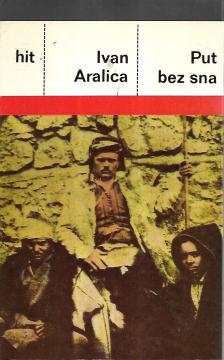
Put bez sna

Put bez sna

Ivan Aralica

The Journey Without Sleep is the first part of Aralica's exile tetralogy. The novel follows the migration of Croats from Rama in 1687 and the fate of Friar Pavle Vučković, Šimun Grabovac, and their people in the face of the Ottoman threat.

The Journey Without Sleep is one of the most important historical novels by Ivan Aralica and the first part of the so-called exile tetralogy, which is continued by Souls of the Slaves, The Inn Builder and Asmodeus Scarf. The plot is set in 1687, during the time of the great wars between the Ottoman Empire and the Venetian Republic and the mass migration of the Croatian population from the Rama Valley towards Dalmatia.

The main characters are the Rama friar Pavle Vučković and Šimun Grabovac, the son of a village blacksmith, an exceptionally capable craftsman who knows several trades. The novel begins with their journey to Split at the invitation of the Venetian commander Antonio Zeno. This invitation sets in motion a series of events that reveal the political games of the great powers and the difficult fate of the people that lies between them.

Through letters, reports, conversations and memories, Aralica shows how fear, insecurity and rumors of the upcoming migration spread among the population. Friar Pavle tries to protect the people and preserve their identity, while Šimun represents an ordinary man who must make decisions about the survival of his family and community. The novel describes in detail the preparations for leaving his homeland, negotiations with the Venetian authorities, betrayals by local powerful people, and the position of people who become pawns in the political plans of others.

The central theme is not just migration but the question of the price of survival. Aralica shows how wars and political decisions affect ordinary people and poses a dilemma between serving the powerful and preserving one's own identity. Historical events are presented through concrete human destinies, which is why the novel acts as a chronicle of a people at a time when its survival is threatened.

Dimensions
20 x 12 cm
Pages
305
Publisher
Znanje, Zagreb, 1987.
 
Distribution: 10,000 copies
 
Latin alphabet. Hardcover with dust jacket.
Language: Croatian.

Multiple copies are available

Copy number 1

Condition:Used, very good condition

Copy number 2

Condition:Used, excellent condition
Damages or inconvenience notice:
  • Traces of patina

Copy number 3

Condition:Used, very good condition
Damages or inconvenience notice:
  • The cover is missing
 

Are you interested in another book? You can search the offer using our search engine or browse books by category.

You may also be interested in these titles

Psi u trgovištu

Psi u trgovištu

Ivan Aralica

Ivan Aralica's novel Dogs in the Market Place (1986) is set in 18th-century Dalmatia, during the period of Venetian rule. The work is a historical novel with elements of philosophical reflection, characteristic of Aralica's style.

Večernji list, 2004.
Croatian. Latin alphabet. Hardcover with dust jacket.
3.86 - 3.92
Duše robova

Duše robova

Ivan Aralica

Ivan Aralica's Souls of Slaves is a historical novel depicting the life of the Croatian people under Ottoman rule. The work explores issues of freedom, identity, religion, and human dignity.

Znanje, 1988.
Croatian. Latin alphabet. Hardcover with dust jacket.
5.30
Naivci

Naivci

Ivan Kušan

This is a humorous and satirical story about life in a small Dalmatian town, told through the perspective of a naive but insightful narrator.

Znanje, 1975.
Croatian. Latin alphabet. Hardcover with dust jacket.
3.64
Jednom ko nijednom

Jednom ko nijednom

Jacqueline Susann

This novel is about a beautiful, noble, and rich girl who seemingly has everything, but is still deeply unhappy and ends her life tragically.

Znanje, 1974.
Croatian. Latin alphabet. Hardcover with dust jacket.
3.48
Konačna dijagnoza

Konačna dijagnoza

Arthur Hailey

Arthur Hailey's Final Diagnosis is a medical novel set in a large hospital. Through the fates of doctors and patients, it depicts responsibility, professional errors, and the conflict between tradition and progress in medicine.

Znanje, 1972.
Croatian. Latin alphabet. Hardcover with dust jacket.
4.42
Život je negdje drugdje

Život je negdje drugdje

Milan Kundera

Jaromil, a young poet raised by a possessive mother, seeks a "real life" in poetry and revolution. His lyrical youth, love, and idealism lead him into conformity and betrayal of intimate relationships – he dies young and unfulfilled.

Znanje, 1979.
Croatian. Latin alphabet. Hardcover with dust jacket.
4.86