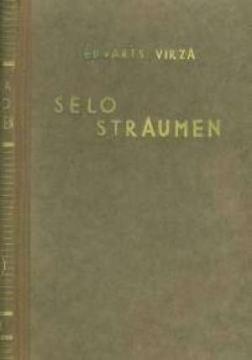
Selo Straumen: kronika lotiškog imanja
Antikvitet

Selo Straumen: kronika lotiškog imanja

Edvarts Virza

In the novel Straumen Village, Edvarts Virza depicts the idealized life of a Latvian village through the cycle of the seasons, emphasizing the collective, tradition, and harmony of man with nature.

Edvarts Virza in his work The Village of Straumen (1933) creates one of the most recognizable works of Latvian interwar literature, which can be understood as a poetic chronicle of idealized rural life.

For the reader unfamiliar with the Latvian literary tradition, it is important to emphasize that Straumēni does not function as a classic novel with a single protagonist and a clear plot line, but as a lyrical-epic depiction of a rural community. The work is often described as a rural epic, because the focus is not on the individual but on the collective – the family and the peasants living in harmony with natural cycles.

The plot is organized around the change of seasons, which determines the rhythm of life: spring brings the beginning of work and renewal, summer an intensive agricultural cycle, autumn the harvest and a sense of fulfillment, and winter a retreat into an enclosed, family space and reflection. This builds the idea of ​​a stable, almost archetypal order in which man, land and tradition are interconnected.

In a broader cultural context, the work was created in a period when Latvian literature strongly affirmed national identity and rural values, often idealizing the village as a bearer of moral and cultural stability. Straumen Village is therefore read not only as a depiction of rural life, but also as a symbolic construction of national space and collective memory.

Stylistically, Virza uses highly stylized, rich and rhythmic language, close to poetry, which gives everyday village chores a monumental, almost mythical dimension. It is this combination of realism of details and idealization that makes the work one of the canonical texts of 20th-century Latvian literature.

Naslov izvornika
Straumēni
Prijevod
Ivan Esih
Dimenzije
18 x 13 cm
Broj strana
212
Nakladnik
Suvremena biblioteka, Zagreb, 1943.
 
Latinica. Tvrde korice.
Jezik: Hrvatski.

Jedan primjerak je u ponudi

Stanje:Korišteno, u vrlo dobrom stanju
Oštećenja / nepogodnosti:
  • Traces of patina
Dodano u košaricu!
 

Zanima Vas i neka druga knjiga? Možete pretražiti našu ponudu pomoću tražilice ili prelistati knjige po kategorijama.

Možda će Vas zanimati i ovi naslovi

I ne reče ni reči

I ne reče ni reči

Heinrich Böll

In Boll's novels, one of the central themes is the attempt to preserve basic moral values ​​in a time of terror, as well as in a period of material prosperity and corruption.

Svjetlost, 1965.
Srpski. Latinica. Broširano.
3,22 - 3,98
Crveni krin

Crveni krin

Anatole France

The Red Lily (1894) is not just a story of forbidden passion – it is a subtle, ironic fresco of a world in which love, politics, and art intertwine in a thin, almost transparent web of conventions and desires.

Svjetlost, 1961.
Srpski. Latinica. Tvrde korice.
2,34 - 4,26
Naša nestala srca

Naša nestala srca

Celeste Ng

The book Our Missing Hearts by Celeste Ng is a powerful and moving story about love, resistance and the search for justice in a world filled with fear and division.

Mozaik knjiga, 2023.
Hrvatski. Latinica. Broširano.
12,36
Krvava arena

Krvava arena

Vicente Blasco Ibanez

The Bloody Arena (1908) is a naturalistic novel about the rise and fall of bullfighter Juan Gallardo. A poor young man becomes a famous matador, but is destroyed by love, vice, fear, and tragedies in the arena – a critique of Spanish bullfighting and soci

Naprijed, 1984.
Hrvatski. Latinica. Tvrde korice s ovitkom.
4,76
Vrijeme nasilja

Vrijeme nasilja

Jean-Pierre Simon

Vrijeme nasilja (1966.) je antiratni i angažirani roman francuskog pisca Jean-Pierrea Simona, manje poznatog autora iz sredine 20. stoljeća, čije djelo nosi tragove ljevičarske literature 1930-ih i 1940-ih.

Svjetlost, 1965.
Hrvatski. Latinica. Broširano.
2,46
Na selu

Na selu

Ivan Potrč

"Na selu" roman je slovenskog književnika Ivana Potrča, objavljen 1974. godine. Djelo se bavi životom slovenskih seljaka, prikazujući njihove svakodnevne izazove i društvene promjene u ruralnoj zajednici.

Spektar, 1974.
Hrvatski. Latinica. Tvrde korice.
3,26