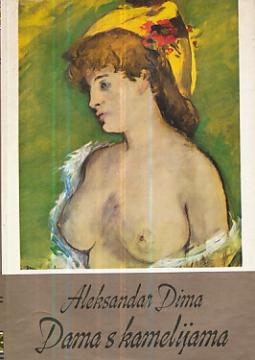
Dama s kamelijama

Dama s kamelijama

Alexandre Dumas-Sin

The young Armand Duval falls in love with the courtesan Marguerite Gautier, known as the Lady with the Camellias. Their passionate love is destroyed by social prejudice and victimhood.

The Lady of the Camellias (French: La Dame aux camélias, 1848) is the most famous work of Alexandre Dumas-son and one of the greatest novels of the 19th century. The work is partly autobiographical – it is based on the author’s relationship with the courtesan Marie Duplessis. The novel achieved enormous success, was adapted into a stage play (1852), and also served as the template for Verdi’s opera La Traviata.

The story is told in the first person. The young Armand Duval, a member of the bourgeois class, falls in love with Marguerite Gautier, a famous Parisian courtesan who wears camellias as her trademark. Marguerite is sick (tuberculosis), sophisticated, beautiful and intelligent, but lives on the fringes of society. Armand’s pure love touches her, so she abandons her previous life and moves with him to the countryside. However, Armand’s father intervenes – he fears a scandal and the destruction of his son’s future. Marguerite sacrifices herself for her love for Armand: she returns to her old life and dies in poverty and loneliness. Armand learns the truth only after her death.

The novel is a classic story of forbidden love, social conventions and sacrifice. Dumas-son criticizes the hypocrisy of Parisian high society, which accepts courtesans as entertainment, but rejects them as soon as they try to live “honestly”. Marguerite is a multi-layered character: she is not just a “fallen woman”, but a woman seeking true love and dignity in a world that denies her this. Armand represents a romantic idealist whose passion collides with reality.

The style is sentimental, melodramatic, but with deep psychological conviction. Dumas masterfully depicts the Parisian demi-monde of the 1840s: balls, theaters, luxury and hidden misery. The novel influenced all of European literature and culture – it became the prototype of the “lady of the camellias” (courtesan with a noble heart).

Original title
La dame aux camelias
Translation
Živojin Živojinović
Dimensions
20 x 14.5 cm
Pages
229
Publisher
Minerva, Subotica, 1984.
 
Distribution: 10,000 copies
 
Latin alphabet. Hardcover with dust jacket.
Language: Serbian.

Two copies are available

Copy number 1

Condition:Used, very good condition
Damages or inconvenience notice:
  • Traces of patina

Copy number 2

Condition:Used, very good condition
Damages or inconvenience notice:
  • Traces of patina
  • The cover is missing
 

Are you interested in another book? You can search the offer using our search engine or browse books by category.

You may also be interested in these titles

Dama s kamelijama

Dama s kamelijama

Alexandre Dumas-Sin

This is the story of the love of two young people, Marguerite Gautier and Armand Duval. Although relationships between men and women have always been complicated enough on their own, this is no typical tale of unrequited love.

Večernji list, 2004.
Croatian. Latin alphabet. Hardcover with dust jacket.
4.24 - 6.24
Die Kameliendame

Die Kameliendame

Alexandre Dumas-Sin

The young Armand Duval falls in love with the courtesan Marguerite Gautier, known as the Lady with the Camellias. Their passionate love is destroyed by social prejudice and victimhood.

Deutscher Bücherbund, 1978.
German. Latin alphabet. Hardcover with dust jacket.
7.32
Evgenija Grande / Muzej starina

Evgenija Grande / Muzej starina

Honore de Balzac

In his novels Eugenie Grandet (1833) and The Museum of Antiquities (1837), Balzac explores universal themes of greed, human passions, sacrifice, and moral dilemmas, placing them in different social contexts of 19th-century French society.

Svjetlost, 1963.
Croatian. Latin alphabet. Hardcover.
3.48
Pod plaštom noći

Pod plaštom noći

Claude Aveline

This collection is perfect for fans of psychological mysteries like Agatha Christie or Simenon, but with a French poetic touch.

Kosmos, 1958.
Serbian. Latin alphabet. Paperback.
2.12 - 2.14
Colomba

Colomba

Prosper Mérimée

Prosper Mérimée's novella, published in 1840, is set in Corsica and explores themes of revenge, honor, and the conflict between the traditional and modern worlds. The novella culminates in a tragic conflict, where love, duty, and violence intertwine.

Zora, 1950.
Croatian. Latin alphabet. Paperback.
2.44 - 2.48
Pobjeda redovnica

Pobjeda redovnica

The Victory of the Nuns is an erotic novel by Jacques Rochette de La Morlière (often anonymous), part of Les Lauriers ecclésiastiques, which satirizes ecclesiastical hypocrisy through libertine adventures. With a foreword by Michel Camus.

Logos, 1988.
Croatian. Latin alphabet. Hardcover with dust jacket.
7.325.49