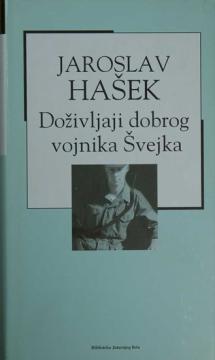
Doživljaji dobrog vojnika Švejka

Doživljaji dobrog vojnika Švejka

Jaroslav Hašek

One of the most popular works of world humorous prose, written between 1921 and 1923. The satirical anti-war story follows Josef Švejk, a simple-minded Czech soldier, during World War I in the Austro-Hungarian Monarchy.

Švejk, a dog dealer from Prague, is drafted into the army, and his seemingly idiotic obedience and literal understanding of orders cause chaos, mocking military bureaucracy and the absurdity of war. The plot follows Švejk's adventures from recruitment, through military hospitals and prisons, to the front.

Through a series of episodes, Hašek depicts his conversations with superiors, such as Lieutenant Lukaš, and other soldiers, where Švejk's witty anecdotes and endless stories expose the absurdity of authority and war ideologies. His apparent stupidity is actually a subtle rebellion against the system. The novel abounds in humor, ironic commentary, and criticism of social norms, especially military discipline and nationalism.

The work, divided into four parts, remained unfinished due to Hašek's death in 1923, with about 800 pages in total. It is written in a vivid, colloquial language, which emphasizes Švejk's ethnic origin. Švejk is a universal satire on human nature and the futility of war, leaving a lasting impact on world literature.

Original title
Osudy dobrebo vojaka Švejka
Translation
Nada Gašić
Dimensions
21 x 21.5 cm
Pages
760
Publisher
Jutarnji list, Zagreb, 2004.
 
Latin alphabet. Hardcover with dust jacket.
Language: Croatian.
ISBN
9-53-716029-7

Multiple copies are available

Copy number 1

Condition:Used, excellent condition

Copy number 2

Condition:Unused

Copy number 3

Condition:Used, excellent condition

Copy number 4

Condition:Used, excellent condition
 

Are you interested in another book? You can search the offer using our search engine or browse books by category.

You may also be interested in these titles

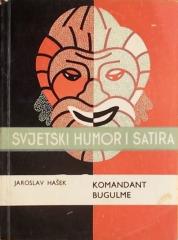
Komandant Bugulme

Komandant Bugulme

Jaroslav Hašek
Naprijed, 1964.
Croatian. Latin alphabet. Paperback.
4.993.74
Humoreske

Humoreske

Jaroslav Hašek

The collection "Humoreske" presents a vivid, humorous and critical cross-section of Hašek's short prose.

Kultura, 1954.
Croatian. Latin alphabet. Hardcover.
3.98
Figarova ženidba ili Ludi dan: Komedija u pet ćinova

Figarova ženidba ili Ludi dan: Komedija u pet ćinova

Pierre-Augustin Caron de Beaumarchais

The comedy "The Marriage of Figaro, or The Mad Day" (1784) is a sequel to The Barber of Seville. The Marriage of Figaro criticizes social injustices through love affairs and intrigue, celebrating Figaro and Susanna's ingenuity in the fight against aristoc

Srpska književna zadruga (SKZ), 1925.
Serbian. Cyrillic alphabet. Hardcover.
7.58
Mjesec iznad Splita

Mjesec iznad Splita

Predrag Lucić

Predrag Lucić's second book of poetry, after "The Lovers from Verona" (2007), is a collection of irony, melancholy and contempt for canons - a dedication to the "ridicules" of Split, those who have woven their antics into the city's collective memory.

Algoritam, 2012.
Croatian. Latin alphabet. Paperback.
6.345.07
Gradić gdje je vrijeme stalo

Gradić gdje je vrijeme stalo

Bohumil Hrabal

Bohumil Hrabal, a Czech writer known for his lyrical grotesque and humor, in his novel The Town Where Time Stood Still evokes childhood in the small town of Libeň (part of Prague), where time seems to stand still in a magical but melancholic world.

Hena Com, 2006.
Croatian. Latin alphabet. Paperback.
7.62