Sibirski pečat

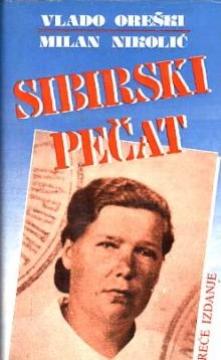
Sibirski pečat

Vlado Oreški, Milan Nikolić

Memoirs of Agata Oreški (1906-1991), a Croatian revolutionary and the only woman from Yugoslavia to survive Stalin's concentration camps. The book was compiled by her son Vlado Oreški and Milan Nikolić, with a foreword by Slavko Goldstein.

The book provides testimony about the eight-year ordeal in the Soviet gulags from 1937 to 1945, during the Great Purge. In 1935, the Central Committee of the Communist Party of Yugoslavia, at the suggestion of Josip Broz Tito, sent Agata – the widow of the murdered SKOJ secretary Mijo Oreški – with her 8-year-old son Vladimir to the USSR, to escape persecution and poverty in the Kingdom of Yugoslavia. Instead of safety, Agata fell into Stalin's terror: the NKVD took her child away from her (who was sent to an orphanage), arrested her in 1937 on charges of being a "Yugoslav spy". After torture, endless interrogations and torture (physical and psychological), she was sentenced to 8 years without admitting guilt.

The path of Calvary leads through the prison in Bryansk (where she suffers from hunger, disease and abuse), the Arkhangelsk concentration camp (cold, forced labour), the Papinka death camp (high mortality, starvation, epidemics) and Talaga (Siberian mines, exhausting work at -50°C, loss of comrades). Agata describes daily life in hell: crumbs of food, diseases (typhoid, dysentery), suicides, but also the solidarity of the prisoners – mostly women from various countries, including Yugoslavs and internationalists. She survives through willpower, faith in communism (which betrayed her) and maternal care for her son, whom she meets again in 1945 in Zagreb, thanks to Tito's diplomatic interventions.

The book exposes the paradox of communist idealism: a humanitarian "way out" turns into a nightmare of betrayal. Agata, an unyielding idealist, bears witness to the dehumanisation in the gulag – a symbol of totalitarianism – but also to human resilience, friendship and hope. The pessimistic tone is reminiscent of Solzhenitsyn, but with an intimate, feminine perspective: maternal love against the machinery of evil.

Goldstein's foreword contextualizes the events within Stalin's purges, where Yugoslav communists (accused of Trotskyism) also suffered. This testimony is not just a personal story, but a warning about the dangers of fanaticism and totalitarianism. Agata's courage leaves a "Siberian stamp" - a scar of survival that shapes history.

Dimensions
21 x 13 cm
Pages
258
Publisher
Sveučilišna naklada Liber (SNL), Zagreb, 1983.
 
Latin alphabet. Hardcover with dust jacket.
Language: Croatian.

Multiple copies are available

Copy number 1

Condition:Used, excellent condition

Copy number 2

Condition:Used, excellent condition

Copy number 3

Condition:Used, excellent condition

Copy number 4

Condition:Used, excellent condition
 

Are you interested in another book? You can search the offer using our search engine or browse books by category.

You may also be interested in these titles

Radni logor Valpovo 1945.-1946.: dokumenti

Radni logor Valpovo 1945.-1946.: dokumenti

Vladimir Geiger

Radni logor Valpovo (1945.–1946.) bio je najveći logor za Folksdojčere u Hrvatskoj nakon II. svjetskog rata. Internirano oko 4.000 Nijemaca i Austrijanaca; umrlo najmanje 1.074, uglavnom od gladi, bolesti i iscrpljujućeg rada.

Njemačka zajednica podunavskih Švaba u Hrvatskoj, 1999.
Croatian. Latin alphabet. Hardcover.
27.34
Projekt Guevara: Snovitim stazama svjetske revolucije

Projekt Guevara: Snovitim stazama svjetske revolucije

Gerd Koenen

Ova je knjiga životopis povijesne ličnosti i ikone dvadesetog stoljeća Ernesta Chea Guevare - u svjetlu njegova projekta jedne svjetske revolucije, koji će Koenen, po Bruceu Chatwinu, nazvati snovitim stazama.

Durieux, 2011.
Croatian. Latin alphabet. Hardcover with dust jacket.
17.6213.22
Teror narodu: Povijest OZNE, Titove političke policije

Teror narodu: Povijest OZNE, Titove političke policije

William Klinger

U knjizi povjesničar William Klinger istražuje nastanak i djelovanje OZNE – brutalnog represivnog aparata komunističke Jugoslavije, koji je nadzirao, zatvarao i likvidirao političke protivnike.

Večernji list, 2014.
Croatian. Latin alphabet. Paperback.
7.34
Partizanska i komunistička represija i zločini u Hrvatskoj 1944.-1946.: dokumenti. Knjiga 2: Slavonija, Srijem i Baranja

Partizanska i komunistička represija i zločini u Hrvatskoj 1944.-1946.: dokumenti. Knjiga 2: Slavonija, Srijem i Baranja

Vladimir Geiger

Die erste kritische Ausgabe von Originaldokumenten (187 an der Zahl) von Einheiten und Institutionen der NOV und PO Jugoslawiens und Kroatiens über die Aktionen gegen besiegte militärische und politische Gegner im Gebiet Slawoniens, Srijems und Baranjas v

Hrvatski institut za povijest, 2006.
Croatian. Latin alphabet. Hardcover.
15.42
Snažan eho brionski: Odjeci Brionskog plenuma u Bosni i Hercegovini 1966. godine

Snažan eho brionski: Odjeci Brionskog plenuma u Bosni i Hercegovini 1966. godine

Amir Duranović

Amir Duranovićs Buch rekonstruiert detailliert das dramatische Jahr 1966 und die vierte (Brion) Sitzung des Zentralkomitees der Kommunistischen Partei Jugoslawiens (1.–2. Juli 1966), auf der Aleksandar Ranković, der langjährige Vorsitzende der UDB und Viz

Udruženje za modernu historiju (UMHIS), 2017.
Croatian. Latin alphabet. Paperback.
9.54
Doživljaji i putovanja do slobode

Doživljaji i putovanja do slobode

Vladimir Novak

Das autobiografische Werk des kroatischen kommunistischen Aktivisten Wladimir Novak, eines Überlebenden der Ustascha-Lager, schildert seine Erinnerungen an den Widerstand gegen den Faschismus während des Zweiten Weltkriegs.

August Cesarec, 1979.
Croatian. Latin alphabet. Hardcover with dust jacket.
8.26