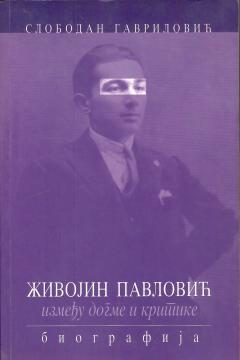
Živojin Pavlović: Između dogme i kritike

Živojin Pavlović: Između dogme i kritike

Slobodan Gavrilović

In terms of the number and content of facts, systematics, and method of interpretation, Gavrilović's work surpasses ordinary historiographical reading and stands side by side with the best literary creations about the events of one time and their actors.

In addition to the introductory text ("The False Myth as a Riddle"), another 10 chapters (with titles and subtitles appropriate to the content and contemporary journalistic style) present an especially exciting life story, "testifying to a tragic life and the time in which it was lived". This is followed by an abundance of contributions "What are his yesterday's friends saying about Pavlović"; "Others wrote about Pavlović"; "Conversations about Živojin Pavlović"; "Correspondence about Živojin Pavlović" and "Correspondence of Živojin and Fernande Pavlović". Along with important information about the sources, an exceptional panorama of characters, situations, plot... is given, which bring Živojin's tragic odyssey to life.

Illustrations
Vladimir Sivdžević-Volođa, Miloš Cvetković
Graphics design
Vladimir Sivdžević-Volođa
Dimensions
21 x 14 cm
Pages
340
Publisher
Grafocard, Beograd, 2001.
 
Cyrillic alphabet. Paperback.
Language: Serbian.

One copy is available

Condition:Used, excellent condition
Specificity of this instance:
Author signature
Dedication
 

Are you interested in another book? You can search the offer using our search engine or browse books by category.

You may also be interested in these titles

Istorija Pariske komune 1871.

Istorija Pariske komune 1871.

Prosper-Olivier Lissagaray

Prosper-Olivier Lissagaray, a French journalist, politician, and participant in the Paris Commune, wrote History of the Paris Commune in 1871 as a detailed account of the events that marked the first workers' government in history.

Mladost, 1946.
Serbian. Latin alphabet. Hardcover.
8.26
Ljubljana u borbi 1941–1945: Zbornik sećanja

Ljubljana u borbi 1941–1945: Zbornik sećanja

The collection brings together the memories of participants in the national liberation struggle in Ljubljana during World War II. The collection contains personal testimonies, which provide insight into the everyday life, struggle and sacrifices of the in

Vojnoizdavački zavod, 1978.
Serbian. Latin alphabet. Hardcover with dust jacket.
9.76
Sudbonosni podvig Jugoslavije: Podsjećanje na historijsko NE staljinizmu, događaj koji je opredijelio budućnost Jugoslavije

Sudbonosni podvig Jugoslavije: Podsjećanje na historijsko NE staljinizmu, događaj koji je opredijelio budućnost Jugoslavije

Raif Dizdarević

The book by Raif Dizdarević, one of the last living actors of Yugoslav diplomacy, presents his reconstruction of the most fateful moment of post-war Yugoslavia – the split with Stalin and the Informburo in 1948–1953.

Udruženje za modernu historiju (UMHIS), 2018.
Croatian. Latin alphabet. Paperback.
23.58
Projekt Guevara: Snovitim stazama svjetske revolucije

Projekt Guevara: Snovitim stazama svjetske revolucije

Gerd Koenen

This book is a biography of the historical figure and icon of the twentieth century, Ernesto Che Guevara - in light of his project of a world revolution, which Koenen, after Bruce Chatwin, will call dream paths.

Durieux, 2011.
Croatian. Latin alphabet. Hardcover with dust jacket.
17.6214.10
Sam protiv njih

Sam protiv njih

Roman Leljak

A non-fiction work by a Slovenian investigator of the UDB archives. The author, a former KOS employee, left the army after learning about the crimes of the Yugoslav army during the war and the post-war period, and dedicated himself to exposing the secret

Vlastita naklada, 1990.
Croatian. Latin alphabet. Paperback.
16.42
Zaraćeno poraće: Konfliktni i konkurentski narativi o stradanju i iseljavanju Talijana Istre

Zaraćeno poraće: Konfliktni i konkurentski narativi o stradanju i iseljavanju Talijana Istre

Franko Dota

The book analyzes how conflicting historical narratives about the suffering and mass emigration of Italians from Istria and Rijeka developed in Croatia and Italy after World War II (1943–1956), debunking myths and encouraging an empathetic approach to the

Srednja Europa, 2010.
Croatian. Latin alphabet. Paperback.
11.328.49