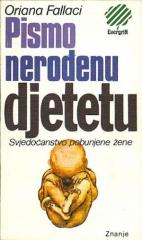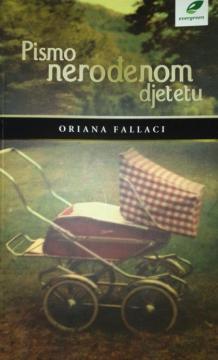
Pismo nerođenom djetetu

Pismo nerođenom djetetu

Oriana Fallaci

One of the most moving and courageous works of world literature of the 20th century. Written as a long monologue by a pregnant woman (Fallaci herself), the book is at once an intimate confession, a feminist manifesto, and a philosophical confrontation wit

The heroine is an independent, world-famous journalist who accidentally becomes pregnant. Instead of joy, she feels fear, anger, and rebellion: will the child be a “parasite” that will steal her freedom, career, and identity? In nightly conversations with the child in her womb, she begs him to decide for himself whether to be born or not – because she cannot make the decision herself. She questions patriarchal lies about the “sacred duty” of motherhood, a woman’s right to her body, fear of responsibility, but also the deep love that is born against her will.

The book culminates in a real tragedy – the miscarriage of pregnancy. The last pages are the cry of a mother who realizes that she did want the child, but too late. Fallaci offers no consolation or moralizes; her language is raw, poetic, and ruthless. The work caused a worldwide scandal in 1975, was banned, and the author was called out by both feminists and the Church. Today it is considered a classic of feminist literature and one of the most poignant testimonies about women's freedom and the price it pays.

Original title
Lettera a un bambino mai nato
Translation
Ladislav Grakalić
Editor
Davor Usoković
Dimensions
20.5 x 12.5 cm
Pages
114
Publisher
Znanje, Zagreb, 2009.
 
Latin alphabet. Paperback.
Language: Croatian.
ISBN
978-9-53195-758-8

One copy is available

Condition:Unused
 

Are you interested in another book? You can search the offer using our search engine or browse books by category.

You may also be interested in these titles

Pismo nerođenu djetetu: Svjedočanstvo pobunjene žene

Pismo nerođenu djetetu: Svjedočanstvo pobunjene žene

Oriana Fallaci

The touching and painfully honest dialogue of a mother with her unborn child, written by the famous Italian journalist and writer Oriana Fallaci, has been delighting generations of readers around the world for decades.

Znanje, 1980.
Croatian. Latin alphabet. Paperback.
4.26
Dnevnici, 1. svezak: 1909-1912.

Dnevnici, 1. svezak: 1909-1912.

Franz Kafka

Kafkas posthum veröffentlichte Tagebücher geben Einblick in die Innenwelt eines ängstlichen Genies. Der erste Band schildert seine frühen Jahre, als Kafka in Prag als Versicherungsangestellter arbeitete und mit einem eintönigen Leben und literarischen Amb

Tim press, 2022.
Croatian. Latin alphabet. Paperback.
15.42
Kad ste utopljeni u plamenu

Kad ste utopljeni u plamenu

David Sedaris

Wenn Sie der Meinung sind, dass unter der Oberfläche des manchmal eintönigen Alltags eine urkomische Absurdität verborgen liegt, wird David Sedaris Sie schließlich davon überzeugen.

Algoritam, 2010.
Croatian. Latin alphabet. Paperback.
3.98
Imenik lijepih vještina I-II

Imenik lijepih vještina I-II

Miljenko Jergović

Im „Verzeichnis der Schönen Künste“ erkundet Miljenko Jergović vielfältige Themen von Literatur bis Geschichte und würdigt Kunst und Exzellenz. Seine Essays zeugen von tiefem Verständnis, durchdrungen von intellektueller Leidenschaft und Liebe zum geschri

24 sata, 2018.
Croatian. Latin alphabet. Hardcover with dust jacket.
The book consists of two volumes
34.56
I drugi su pjevali o ratu: Odjeci raspada Jugoslavije u engleskoj i američkoj književnosti

I drugi su pjevali o ratu: Odjeci raspada Jugoslavije u engleskoj i američkoj književnosti

Muharem Bazdulj

In diesem Essayband analysiert Muharem Bazdulj, wie der Zusammenbruch Jugoslawiens und die Kriege der 1990er Jahre in der angelsächsischen Literatur widerhallten – von Vorkriegsstereotypen bis hin zu Kriegs- und Nachkriegsdarstellungen.

Biblioteka XX vek, 2013.
Croatian. Latin alphabet. Paperback.
8.24
Primicanje katastrofa: Propasti koje prijete našem svijetu

Primicanje katastrofa: Propasti koje prijete našem svijetu

Isaac Asimov

Ein populärwissenschaftliches Werk, in dem Asimov, wissenschaftliche Genauigkeit mit einem klaren Stil verbindend, mögliche Bedrohungen für das Überleben der Menschheit untersucht und Katastrophen nach ihrer Art und Wahrscheinlichkeit systematisiert.

August Cesarec, 1981.
Croatian. Latin alphabet. Hardcover with dust jacket.
7.46