Hamsin 51

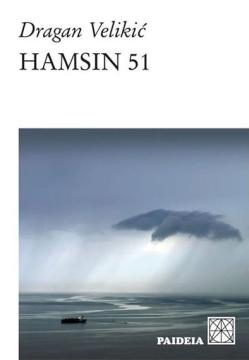
Hamsin 51

Dragan Velikić

The novel Hamsin 51 (1993) is one of Dragan Velikić's early highlights – a spectacular family saga and anti-war work written in the midst of the breakup of Yugoslavia, with an ending that will take place three decades later – in 2022.

The title alludes to the hamsin (a warm, desert wind from the south), a symbol of chaos and change. The plot spans time: it begins in 1972 when poet Nikola Gavrić finds the manuscript of his father Žarko Gavrić, an undergraduate law student who is searching for traces of Dositej Obradović and Njegoš in Italy. This search opens up layers of family history, identity, and intellectual wandering.

The main part is set in the early 1990s: Belgrade is once again a post-war city, full of gray ruins, weeds growing through cracks (e.g., the Turkish Baths, Nebojša Tower). The novel follows the intellectual emigration caused by the collapse of the SFRY – displaced lives, exile, loss of home, and national madness. Velikić boldly projects the ending in 2022 – a futuristic view of the scattered destinies after three decades of transition, war, and calm.

The untamed storytelling spirit connects different historical moments, memories, anticipations and the main character's poem into a solid whole. The psychological pulse is accompanied by a filigree chiseled sentence – a mixture of real and imagined, generated by the inextricable reality of war.

Dimensions
17 x 12 cm
Pages
150
Publisher
PAIDEIA, Beograd, 2012.
 
Latin alphabet. Paperback.
Language: Serbian.

One copy is available

Condition:Unused
 

Are you interested in another book? You can search the offer using our search engine or browse books by category.

You may also be interested in these titles

Ruski prozor

Ruski prozor

Dragan Velikić
Stubovi kulture, 2008.
Serbian. Latin alphabet. Paperback.
7.56
Ruski prozor

Ruski prozor

Dragan Velikić

Perhaps the greatest virtue of Velikić's writing, which culminated in this novel, is his extraordinarily refined feeling for life's details, which he depicts and evokes with an almost shamanic power of materialization.

Profil International, 2008.
Croatian. Latin alphabet. Paperback.
6.985.24
Danteov trg

Danteov trg

Dragan Velikić

As in Velikić's previous novels, the heroes weave analogous and often intertwined destinies of frustrated Central European citizens and intellectuals, the topography is very diverse, but also recognizable.

Stubovi kulture, 1998.
Serbian. Latin alphabet. Paperback.
6.72
Usta puna zemlje

Usta puna zemlje

Branimir Šćepanović

The novel "Usta puna zemlje" (1970), the masterpiece of the Serbian writer Branimir Šćepanović, is a psychologically in-depth explorer of the limits of the human soul, solitude and existential freedom, reminiscent of Kafka and Camus.

BIGZ, 1987.
Serbian. Latin alphabet. Paperback.
3.96 - 3.98
Godan

Godan

Munshi Prem Chand
Kosmos, 1960.
Serbian. Latin alphabet. Paperback.
4.22 - 4.26
Proces

Proces

Franz Kafka

Kafka wrote The Process between 1914 and 1915, published posthumously in 1925. The novel is unfinished but with an added final chapter by Max Brod. Edition with a foreword by B. Živojinović and an afterword by Walter Killi.

BIGZ, 1990.
Serbian. Latin alphabet. Paperback.
4.26