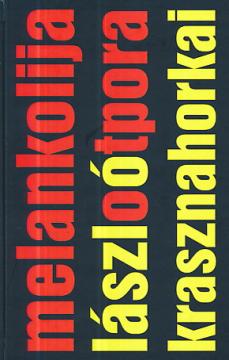
Melankolija otpora

Melankolija otpora

László Krasznahorkai

This novel by László Krasnahorkai introduces the reader to the dark depths of a world devastated in every sense, in which everyday logic no longer applies and in which all usual ideas about life are mercilessly shattered.

The novels The Satanic Tango (1985) and The Melancholy of Resistance (1989) could not remain the great secret of Hungarian literature for long due to their excellence, and László Krasznahorkai soon became a new, unavoidable name on the world literary scene, and today, after publishing about twenty novels, stories, essays, etc., he has entered the shortlist of candidates for the Nobel Prize. He has been praised by prominent authors such as Sebald and Susan Sontag, and he has gained wider popularity through the films he created with Béla Tarr based on his novels and scripts. Their unconventional teamwork resulted in magic, a pulsating combination of the sacred and the demonic, but also the circus and the sublime – an attractive-repulsive intertwining of the worlds of Krasznahorkai's novels and Tarr's films, which are difficult to enter, and even more difficult, much more difficult, if not impossible, to exit. In The Melancholy of Resistance, which New Yorker critic James Wood called "a comedy of the apocalypse," unusual events begin to unfold when a mysterious circus troupe arrives in a small provincial town in southern Hungary with a giant whale that attracts the curious and a charismatic freak, the Prince, who attracts the discontented... In addition to the intriguing plot, the more demanding reader will be attracted by the author's suggestive, meandering long sentences; the dizzying ambiguity of events; the apocalyptic, grotesque scenes that question the possibilities of resistance to the ruling system; and the power of the omniscient narrative voice that describes the most subtle moments of the psychological fluctuations of the novel's heroes... These are just some of the features of Krasznahorkai's fascinating authorial writing, a man who may not, like his hero, have deserved the award "for the simplest and most purposeful way of leading a life," but who "with his extraordinary talent gilded the boredom of everyday life with the sphere of art."

Original title
Az ellenállás melankóliája
Translation
Angela Pataki
Editor
Krunoslav Jajetić
Graphics design
Kruno Jajetić
Dimensions
24 x 15.5 cm
Pages
278
Publisher
Šareni dućan, Koprivnica, 2014.
 
Latin alphabet. Hardcover.
Language: Croatian.

One copy is available

Condition:Used, excellent condition
Damages or inconvenience notice:
  • A message of a personal nature
 

Are you interested in another book? You can search the offer using our search engine or browse books by category.

You may also be interested in these titles

Usta puna zemlje

Usta puna zemlje

Branimir Šćepanović

The novel "Usta puna zemlje" (1970), the masterpiece of the Serbian writer Branimir Šćepanović, is a psychologically in-depth explorer of the limits of the human soul, solitude and existential freedom, reminiscent of Kafka and Camus.

BIGZ, 1987.
Serbian. Latin alphabet. Paperback.
3.98
Malena je ime tanga

Malena je ime tanga

Almudena Grandes

If you like raw eroticism like Cloud Atlas, this is a sensual saga – emotional, provocative, for those who want to feel the pulse of forbidden passion! Grandes probes whether love is a curse or a liberation?

Mozaik knjiga, 2000.
Croatian. Latin alphabet. Hardcover.
8.54
Pripovetke iz levog i desnog džepa

Pripovetke iz levog i desnog džepa

Karel Čapek

These stories deal with different topics, although most deal with different criminal acts, from fraud and fortune-telling to marriage fraud and murder.

Jugoslavijapublik, 1980.
Croatian. Latin alphabet. Hardcover.
5.22
Aurorin poticaj

Aurorin poticaj

Erich Hackl

The work is based on a true event that occurred in Spain in 1933: Aurora Rodriguez killed her daughter Hildegart, a famous fighter for women's emancipation and a cult figure on the political scene of the time.

Mladost, 1990.
Croatian. Latin alphabet. Hardcover with dust jacket.
4.98
Proces

Proces

Franz Kafka

Kafka wrote The Process between 1914 and 1915, published posthumously in 1925. The novel is unfinished but with an added final chapter by Max Brod. Edition with a foreword by B. Živojinović and an afterword by Walter Killi.

BIGZ, 1990.
Serbian. Latin alphabet. Paperback.
4.26
Dok ležah na samrti

Dok ležah na samrti

William Faulkner

Faulkner's 1930 novel, a classic example of modernist literature. It is often compared to Joyce's "Ulysses" for its innovative structure, but is more accessible due to its focus on family.

Rad, 1985.
Croatian. Latin alphabet. Paperback.
3.26