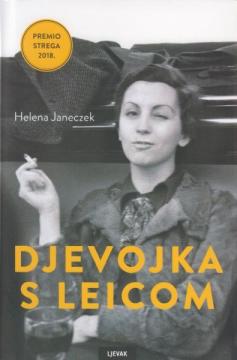
Djevojka s Leicom

Djevojka s Leicom

Helena Janeczek

The novel is a kaleidoscopic, polyphonic account of the life of Gerda Taro (née Gerda Pohorylle, 1910–1937), the first female war photographer to die on the battlefield. A must-read for fans of historical fiction about strong women and anti-fascism.

The novel begins on August 1, 1937 in Paris: a funeral procession with red flags follows the coffin of Gerda Taro, and Robert Capa (Andor Friedmann), her partner and lover, leads the procession in deep mourning.

Janeczek does not narrate linearly, but through the voices of several characters – friends, lovers, colleagues, admirers and random witnesses – who remember Gerda at different times. The voices intertwine in three main parts, creating a mosaic of fragments, memories and perspectives.

Gerda was born into a Jewish family in Stuttgart (Leipzig). As a young leftist and anti-fascist, she fled Nazi Germany in 1933 for Paris. There she met the Hungarian photographer Andor Friedmann (later Robert Capa) – they invented the joint pseudonym "Robert Capa" to sell photographs (she as an "assistant"). Gerda quickly established herself: she learned to take photos with a Leica, became an independent reporter, filmed demonstrations, refugees, the Paris Fair in 1937.

The key part is the Spanish Civil War (1936–1937): Gerda and Capa go to the Republican side, film the battles, civilians, wounded. Her photographs become iconic – brave, empathetic, focused on people, not just action. Gerda is an innovator: the first woman on the front with a camera, anti-fascist, seductress, brave and charismatic.

The novel ends with her death on July 26, 1937 near Bruneta – she was killed in a tank attack (or accident) at the age of 27. Many voices mourn her, but also expose the myth: she is not only Capa's muse, but an independent artist and heroine.

Janeczek subtly reconstructs Gerda through details, anecdotes, emotions – this is a book more about time (the 1930s, the rise of fascism, anti-fascist resistance, exile, love) than a linear biography. The style is lyrical, fragmentary, emotional – a novel about memory, identity, the courage of a woman in a male world of war and art.

Original title
La ragazza con la Leica
Translation
Ita Kovač
Editor
Ivana Mirošević
Illustrations
Robert Capa
Graphics design
Ana Pojatina
Dimensions
21 x 15 cm
Pages
344
Publisher
Naklada Ljevak, Zagreb, 2020.
 
Latin alphabet. Hardcover with dust jacket.
Language: Croatian.

One copy is available

Condition:Unused
 

Are you interested in another book? You can search the offer using our search engine or browse books by category.

You may also be interested in these titles

Dunav: P.S. 1991. vukovarske razglednice

Dunav: P.S. 1991. vukovarske razglednice

Pavao Pavličić

A moving and poignant chronicle of the siege and destruction of Vukovar in 1991 through 57 short "postcard" chapters. Pavličić does not write from the perspective of an "ordinary" Zagreb resident who spent the summer of 1991 in Vukovar, and then followed

Hena Com, 1999.
Croatian. Latin alphabet. Hardcover.
11.26
Baraka Pet Be i druge novele

Baraka Pet Be i druge novele

Miroslav Krleža

The collection "Baraka Pet Be i druge novele" brings a selection of Krleža's anti-war novels from the period 1916–1920s, focusing on the senselessness of World War I, the suffering of the Home Guard and the downfall of Austria-Hungary.

Mladost, 1987.
Croatian. Latin alphabet. Hardcover.
5.38
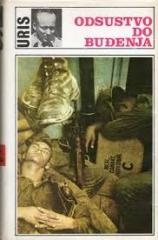
Odsustvo do buđenja

Odsustvo do buđenja

Leon Uris

Battle Cry (1953) is Leon Uris's debut novel based on his experience in World War II as a member of the 6th Marine Regiment.

Otokar Keršovani, 1970.
Croatian. Latin alphabet. Hardcover with dust jacket.
8.24
Armageddon

Armageddon

Leon Uris

Armageddon (1964) by Leon Uris is a historical novel set in post-war Berlin during the 1948-1949 airlift, when the Allies supplied West Berlin amidst the Soviet blockade.

Otokar Keršovani, 1970.
Croatian. Latin alphabet. Hardcover with dust jacket.
8.26
Zaboravljene djevojke

Zaboravljene djevojke

Martha Hall Kelly

The novel The Forgotten Girl is based on the real life of a member of New York's posh circles, who fought for the rights of Kunić, a group of women who survived the horrors of the Ravensbrück concentration camp.

Mozaik knjiga, 2018.
Croatian. Latin alphabet. Paperback.
7.98
Vrijeme nasilja

Vrijeme nasilja

Jean-Pierre Simon

A Time of Violence (1966) is an anti-war and activist novel by French writer Jean-Pierre Simon, a lesser-known author from the mid-20th century, whose work bears traces of leftist literature of the 1930s and 1940s.

Svjetlost, 1965.
Croatian. Latin alphabet. Paperback.
2.46