Dijalektika prijelaznog perioda

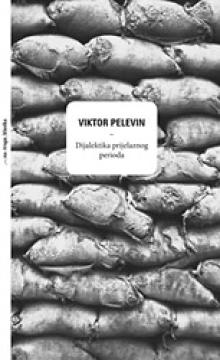
Dijalektika prijelaznog perioda

Viktor Pelevin

The book represents the author's anthology - the largest part is the novel Čisla (Čisla), followed by the short story Macedonian Criticism of French Thought and several short stories (Odin vog, Akiko, Fokus-grupa, Gost na prazniku bon).

At the heart of Chisla's novel is Stepa (Stepan), an oligarch of the new Russian capitalism of the 90s/2000s. He is obsessed with numbers: his "solar" number 34 (symbol of power, success) clashes with "lunar" 43 (symbol of ruin, Chubais and liberals). Stepa builds his life around the numerological cabal - he chooses numbers for phones, rooms, cars, lovers, jobs - believing that in this way he will control destiny. But the crisis of 1998 and the political turmoil shatter the illusion: the numbers turn against him, leading to paranoia, hallucinations and existential decline.

Pelevin mocks post-Soviet Russia: oligarchs, mafia, politics, Buddhism, New Age, capitalism and spirituality as commodities. Dialectic is a parody of Marxism – the transition from nowhere (Soviet nothingness) to nowhere (the new Russian chaos), where nothing changes, only repeats itself in new forms.

The stories are short, absurd, Buddhist-satirical: about virtual sex, Japanese culture, focus groups and "bon" (Buddhist holiday of the dead). The entire book is a cynical, witty critique of the transition – from communism to capitalism, from the material to the virtual, from nothingness to nothingness – with Pelevin's signature blend of philosophy, pop culture and dark humor.

Original title
Диалектика Переходного Периода из Ниоткуда в Никуда
Translation
Irena Lukšić
Illustrations
Stanko Abadžić
Dimensions
20 x 12.5 cm
Pages
316
Publisher
Disput, Zagreb, 2006.
 
Latin alphabet. Paperback.
Language: Croatian.

One copy is available

Condition:Used, excellent condition
 

Are you interested in another book? You can search the offer using our search engine or browse books by category.

You may also be interested in these titles

Ulizica

Ulizica

Françoise Sagan
Naprijed, 1987.
Croatian. Latin alphabet. Hardcover.
2.99
Štefica Cvek u raljama života

Štefica Cvek u raljama života

Dubravka Ugrešić

Do you like "lovelies"? Whatever you think about them, you'll enjoy this superb pastiche of trivial romance novels.

Mladinska knjiga, 1990.
Croatian. Latin alphabet. Hardcover with dust jacket.
4.94
Deobe

Deobe

Dobrica Ćosić

Deobe is a novel about the tragic division of Serbs into Chetniks and Partisans during World War II. Winner of the NIN Award, it is part of a wider epic trilogy, inspired by Ćosić's experiences and historical documents.

Prosveta, 1963.
Croatian. Latin alphabet. Hardcover with dust jacket.
13.74
Bilješka o piscu: Neljubavni roman

Bilješka o piscu: Neljubavni roman

Julijana Matanović

A Writer's Note is the first bestseller by beloved Croatian author Julijana Matanović. A hit since its publication, the novel reminds us that the past cannot be erased, only understood.

Mozaik knjiga, 2002.
Croatian. Latin alphabet. Paperback.
6.36 - 6.38
Krčma

Krčma

Julian Stryjkowski

The book "Inn" by Julian Stryjkowski, published in 1977, explores life in a small Jewish village in Galicia during the 19th century.

BIGZ, 1977.
Serbian. Latin alphabet. Paperback.
4.38
Zagrepčanka

Zagrepčanka

Branislav Glumac

Branislav Glumac published a novel without periods or commas in 1974, as the relentless stream of thought of a young rebel. Published in socialist Yugoslavia, the work caused a scandal with its openness and became a classic about generational rebellion.

IROS, 1986.
Croatian. Latin alphabet. Hardcover.
8.24