Kućni ljudi
Rare book

Kućni ljudi

Almin Kaplan

In the novel Kućni ljudi (People of the House) by Almin Kaplan, the intimate stories of a Herzegovinian family depict everyday life, quiet anxiety, and changes in village life - a meeting of tradition, nostalgia, and contemporary stratification.

Almin Kaplan's Home People is a multi-layered novel that depicts life in a Herzegovinian village through the prism of everyday family life, between reality, memory and quiet melancholy. In a recognizable, lyrical style, the author explores themes of home, belonging and time that inexorably changes everything – from people to their relationships and values.

At the center of the work is a family whose members, each in their own way, struggle with the challenges of modern life and the loss of what they once considered the foundation of existence. The house – as a physical and symbolic space – becomes a place where the past and the present, the living and the dead, happiness and longing meet.

Kaplan's narrative tone is full of quiet empathy, with an emphasis on the details of everyday life and the landscapes of Herzegovina that reflect the emotional states of the characters. Through simple but deeply experienced images, the author shows how complex inner worlds and sadness for a disappearing world are hidden in ordinary people.

The novel is at once an intimate chronicle and a poetic portrayal of the homeland, a dedication to the homeland and to all those who seek – or lose – their place in it.

Editor
Semezdin Mehmedinović
Graphics design
Bojan Hadžihalilović
Dimensions
21 x 13 cm
Pages
363
Publisher
Buybook, Sarajevo, 2022.
 
Latin alphabet. Hardcover.
Language: Croatian.

One copy is available

Condition:Unused
 

Are you interested in another book? You can search the offer using our search engine or browse books by category.

You may also be interested in these titles

Proces

Proces

Franz Kafka

Kafka wrote The Process between 1914 and 1915, published posthumously in 1925. The novel is unfinished but with an added final chapter by Max Brod. Edition with a foreword by B. Živojinović and an afterword by Walter Killi.

BIGZ, 1990.
Serbian. Latin alphabet. Paperback.
4.26
Eva Luna

Eva Luna

Isabel Allende

Eva Luna is a novel about a poor storyteller who weaves lives with words, written by Isabel Allende, the founder of Latin American magical realism. Published after the success of The House of the Spirits, this whirlwind of adventure combines love, revolut

Znanje, 1990.
Croatian. Latin alphabet. Hardcover with dust jacket.
8.36
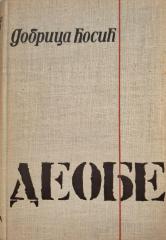
Deobe

Deobe

Dobrica Ćosić

Deobe is a novel about the tragic division of Serbs into Chetniks and Partisans during World War II. Winner of the NIN Award, it is part of a wider epic trilogy, inspired by Ćosić's experiences and historical documents.

Prosveta, 1963.
Croatian. Latin alphabet. Hardcover with dust jacket.
13.74
Aurorin poticaj

Aurorin poticaj

Erich Hackl

The work is based on a true event that occurred in Spain in 1933: Aurora Rodriguez killed her daughter Hildegart, a famous fighter for women's emancipation and a cult figure on the political scene of the time.

Mladost, 1990.
Croatian. Latin alphabet. Hardcover with dust jacket.
4.96 - 4.98
Andrićeva lestvica užasa

Andrićeva lestvica užasa

Svetislav Basara

A Serbian writer known for his satirical novels, Andrić's Ladder of Horrors dissects the Balkan mentality through a parable of Yugo-nostalgia and national myths. The title alludes to Ivo Andrić as a litmus test for criticism – Balkans claim him or reject

24 sata, 2021.
Serbian. Latin alphabet. Paperback.
11.56
Dok ležah na samrti

Dok ležah na samrti

William Faulkner

Faulkner's 1930 novel, a classic example of modernist literature. It is often compared to Joyce's "Ulysses" for its innovative structure, but is more accessible due to its focus on family.

Rad, 1985.
Croatian. Latin alphabet. Paperback.
3.26