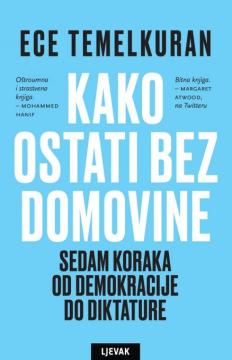
Kako ostati bez domovine: Sedam koraka od demokracije do diktature

Kako ostati bez domovine: Sedam koraka od demokracije do diktature

Ece Temelkuran

In her book, Ece Temelkuran analyzes how societies are gradually sliding into authoritarianism. Through personal experiences and global examples, she reveals patterns of loss of freedom, compassion, and truth in the modern world.

How to Lose a Homeland: Seven Steps from Democracy to Dictatorship is the work of Turkish journalist and writer Ece Temelkuran, who, based on personal experiences and political analysis, describes how democracies around the world are slowly, almost imperceptibly, turning into authoritarian regimes. After having to leave Turkey for writing critically about the government, the author uses her example as a warning – what happened in her country can happen anywhere.

The book is structured in seven steps that lead to the loss of democracy: from the manipulation of public discourse and fake news, through the demonization of “others”, to the complete control of institutions and the breakdown of trust among citizens. Temelkuran compares the processes in Turkey with those in Hungary, the United States, Poland and other countries, emphasizing the universality of political mechanisms that encourage populism and hatred.

The author combines a personal story with an analysis of social trends, writing passionately but lucidly about the erosion of truth and empathy. Despite its pessimistic insights, the book is also an appeal for renewed solidarity, dialogue, and the courage to speak out against injustice.

How to Be Left Without a Homeland is a powerful, engaging work that exposes contemporary threats to democracy and calls on the reader not to be a passive witness to their spread.

Original title
How to Lose a Country: The 7 Steps from Democracy to Dictatorship
Translation
Ivica Buljan
Editor
Nada Brnardić
Dimensions
23 x 15 cm
Pages
195
Publisher
Naklada Ljevak, Zagreb, 2019.
 
Latin alphabet. Paperback.
Language: Croatian.

One copy is available

Condition:Unused
 

Are you interested in another book? You can search the offer using our search engine or browse books by category.

You may also be interested in these titles

O boljševizmu (1920-1921) - zabranjeni Masarik

O boljševizmu (1920-1921) - zabranjeni Masarik

Tomáš G. Masaryk

In this edition, translated by dr. Aleksandar Ilić, there are texts of the first Czechoslovak president in which he timely criticizes Marx, Engels and Lenin, and actually goes on to criticize imperialism in general.

Zavod za udžbenike i nastavna sredstva, 2014.
Serbian. Cyrillic alphabet. Paperback.
9.76
I drugi su pjevali o ratu: Odjeci raspada Jugoslavije u engleskoj i američkoj književnosti

I drugi su pjevali o ratu: Odjeci raspada Jugoslavije u engleskoj i američkoj književnosti

Muharem Bazdulj

In this book of essays, Muharem Bazdulj analyzes how the collapse of Yugoslavia and the wars of the 1990s resonated in Anglo-Saxon literature – from pre-war stereotypes to war and post-war depictions.

Biblioteka XX vek, 2013.
Croatian. Latin alphabet. Paperback.
8.24
Kako sam djeci objasnio demokratiju

Kako sam djeci objasnio demokratiju

Miro Cerar

A book that deals with the concept of democracy from its origins in ancient Greece, through the dark ages of European history when it practically disappeared from the face of the earth, up to the present day.

Buybook, 2014.
Croatian. Latin alphabet. Paperback.
11.98
Hrvatska borba za opstojnost 1918.-1998.

Hrvatska borba za opstojnost 1918.-1998.

Milivoj Kujundžić, Zdravko Dizdar

The book contains an account of the history of Croatia from 1918 to 1998 in four historical periods (1918-1941; 1941-1945, 1945-1990 and 1990-1998).

Hrvatski državni sabor, 2000.
Croatian. Latin alphabet. Hardcover.
6.42
Hrvati i njihov seljački pokret

Hrvati i njihov seljački pokret

Petar Ml. Preradović

"Croats and their peasant movement", by Petra Jr. Preradović, is a historical-political study that analyzes the history of peasant movements in Croatia and their significance in the social and political development of the country.

Hrvatska seljačka stranka - Livana, 1993.
Croatian. Latin alphabet. Paperback.
8.36
Snažan eho brionski: Odjeci Brionskog plenuma u Bosni i Hercegovini 1966. godine

Snažan eho brionski: Odjeci Brionskog plenuma u Bosni i Hercegovini 1966. godine

Amir Duranović

Amir Duranović's book reconstructs in detail the dramatic year 1966 and the Fourth (Brion) Session of the Central Committee of the Communist Party of Yugoslavia (July 1–2, 1966), at which Aleksandar Ranković, the long-time head of the UDB and vice preside

Udruženje za modernu historiju (UMHIS), 2017.
Croatian. Latin alphabet. Paperback.
9.547.63