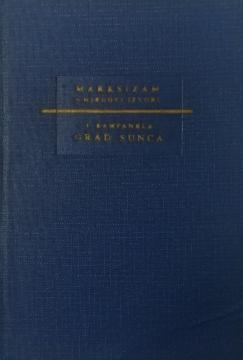
Grad sunca
Rare book

Grad sunca

Tommaso Campanella

The City of the Sun (Latin: Civitas Solis, published in 1623) is a visionary, esoteric, almost mystical utopia, deeply imbued with the Renaissance spirit, Egyptian astrology, and the Christian hope for a perfect society.

Campanella, a Dominican, philosopher, poet and rebel, wrote it in prison, after being tortured and sentenced to death for heresy and conspiracy against the Spaniards – the work emerged from his suffering as a dream of a world without tyranny, poverty and ignorance.

The story is structured as a dialogue: a Genoese sailor tells a Knight Hospitaller about his journey to the miraculous City of the Sun, located on a hill near the equator, surrounded by seven concentric walls named after the planets (Mercury, Venus, Mars, Jupiter, Saturn, Moon, Sun). At the top of the hill stands a temple dedicated to the Sun – a symbol of divine wisdom and natural religion. The city is a microcosm: mathematically perfect, cosmically attuned, where everything is subordinated to the harmony of the universe.

In this city there is no private property – land, houses, food, even women and children are shared. Everyone works four hours a day, the rest is dedicated to learning, art, exercise and prayer. Education begins at birth: children learn from the pictures on the walls (the entire city is a living encyclopedia – the walls are painted with science, history, animals, plants). Marriages are arranged according to eugenics and astrology, and love is subordinated to the common good. Power is held by three rulers: Power (army), Wisdom (science) and Love (health, reproduction) – above them is the Priest-Sun, an enlightened ruler who combines reason and faith.

Campanella mixes Plato, Christianity, Pythagorean numerology and Renaissance science: astrology determines the time for sowing, marriages, wars; religion is natural, without dogmas, directed towards God through the Sun and the stars. There is no poverty, no envy, no war – everything is in harmony with nature and the cosmos.

The City of the Sun is not a cold dystopia; it is a warm, almost poetic dream of humanity overcoming selfishness. Campanella believes that such a city is possible – if people turn to reason, nature and God. The work influenced later utopias, but also thinkers like Campanella himself, who dreamed of a universal monarchy under the pope.

Original title
La città del sole
Translation
Darinka Grabovac
Editor
Dušan Maletić
Dimensions
18 x 12 cm
Pages
132
Publisher
Kultura, Beograd, 1964.
 
Latin alphabet. Hardcover.
Language: Serbian.

One copy is available

Condition:Used, excellent condition
Damages or inconvenience notice:
  • Yellowed pages
 

Are you interested in another book? You can search the offer using our search engine or browse books by category.

You may also be interested in these titles

Arka - Čudesni svijet na granici nauke #72, 1990/X

Arka - Čudesni svijet na granici nauke #72, 1990/X

NIŠRO Oslobođenje, 1990.
Croatian. Latin alphabet. Paperback.
4.00
Eliksir i kamen: Naslijeđe magije i alkemije

Eliksir i kamen: Naslijeđe magije i alkemije

Michael Baigent, Richard Leigh

The book represents the most ambitious attempt by the Baigent-Leigh duo (authors of Holy Blood, Holy Grail) to show how Western culture, art, science, and politics from the Renaissance to the present day are actually the fruit of a single, millennia-old o

Stari grad, 2000.
Croatian. Latin alphabet. Hardcover.
21.22 - 21.32
Talisman: sveti gradovi, tajna vjera

Talisman: sveti gradovi, tajna vjera

Graham Hancock, Robert Bauval

Talisman is an exciting intellectual journey through the hidden streets and underground canals of history in search of traces of the secret religion that shaped the world, hidden in architecture and monuments.

Stari grad, 2006.
Croatian. Latin alphabet. Hardcover.
24.42 - 24.46
Arka - Čudesni svijet na granici nauke #58, 1990/IV

Arka - Čudesni svijet na granici nauke #58, 1990/IV

NIŠRO Oslobođenje, 1990.
Croatian. Latin alphabet. Paperback.
4.00
Ciklus svemirskih katastrofa: Potopi, požari i skapavanja u povijesti civilizacije

Ciklus svemirskih katastrofa: Potopi, požari i skapavanja u povijesti civilizacije

Richard Firestone, Allen West, Simon Warwick-Smith

The book is the most readable and complete overview of the evidence that human civilization has already been nearly wiped out of the universe once – and that such cycles may repeat themselves every few tens of thousands of years.

Stari grad, 2007.
Croatian. Latin alphabet. Hardcover.
21.22 - 21.34
Evolucija božanstva: od sfinge do Krista

Evolucija božanstva: od sfinge do Krista

Édouard Schuré

"The Evolution of Divinity" was published in 1912, and the subtitle "From the Sphinx to Christ" indicates that it is the first part of a larger whole. The second part (which remained unwritten) was supposed to show the esoteric tradition from Christ to Lu

CID-NOVA, 205.
Croatian. Latin alphabet. Paperback.
9.54