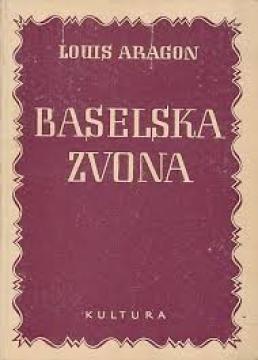
Baselska zvona
Rare book

Baselska zvona

Louis Aragon

The novel follows three women: Diane, a noblewoman; Catherine Simonidzé, a feminist; and the real Clara Zetkin, a communist. Through their destinies, the crisis of bourgeois society, women's emancipation, and the path to communism are depicted.

The Bells of Basel is the first novel in the cycle Le Monde réel (The Real World) by Louis Aragon, published in 1934 (revised in 1964), in which Aragon moves from surrealism to socialist realism and Marxist criticism of society. The title alludes to the bells of Basel – symbolic of the alarm for the awakening of the working class and the end of the bourgeois world, and to the International Congress of Women in Basel in 1912.

The novel is divided into three main parts, each focusing on a single woman:

  • Diane – an aristocrat from a failed noble family, who lives off "rich fiancés" and uses sexuality as power. Her son Guy observes the adult world cynically and satirically – the first part is a comedy of manners, a critique of bourgeois decadence and hypocrisy.
  • Catherine Simonidzé – a young Georgian, the daughter of an oil magnate from Baku, who lives in Paris on her father's checks. She starts out as an anarchist, gets involved in labor movements (taxi strike), falls in love with Victor (a striker), but realizes the limitations of individual rebellion. Her path leads from anarchism to socialism.
  • Clara Zetkin – a real historical figure, German socialist militant and feminist (founder of International Women's Day). She represents the ideal of a revolutionary – dedicated to class struggle, women's emancipation and internationalism.

Through these women's destinies, Aragon dissects pre-war Europe (early 20th century): bourgeois decay, the crisis of patriarchy, women's oppression, class conflicts and the path to revolution. The novel begins satirically and cynically (as a critique of the bourgeoisie), and ends lyrically and idealistically – in communist hope. It is a "thesis novel" that shows how women, of different classes and ideologies, come to the realization that true emancipation is possible only in the socialist struggle.

The style is realistic with elements of lyricism and irony - Aragon uses documentary motifs (strikes, congresses), but also the psychological depth of the characters. The work is important for Aragon's conversion to communism (he became a member of the PCF in 1927) and influenced French left-wing literature in the 30s.

Original title
Les Cloches de Bâle
Translation
Vinko Tecilazić
Dimensions
19.5 x 14 cm
Pages
331
Publisher
Kultura, Beograd, 1946.
 
Latin alphabet. Hardcover.
Language: Serbian.

One copy is available

Condition:Used, very good condition
Damages or inconvenience notice:
  • Damaged back
 

Are you interested in another book? You can search the offer using our search engine or browse books by category.

You may also be interested in these titles

Ljepotica dana

Ljepotica dana

Joseph Kessel

The novel The Beauty of the Day by French author Joseph Kessel, published in 1928, explores the complex psychological and emotional layers of the main character, Séverine Sérizy.

Nakladni zavod Matice hrvatske, 1973.
Croatian. Latin alphabet. Hardcover.
8.46
Eugenija Grande

Eugenija Grande

Honore de Balzac

"Eugénie Grandet" (1833), part of Balzac's Human Comedy, is a realistic novel that explores greed, family relationships, and the sacrifices of love in provincial French society.

Svjetlost, 1970.
Croatian. Latin alphabet. Hardcover.
4.99 - 5.00
Opasne veze

Opasne veze

Choderlos de Laclos

Dangerous Liaisons is an epistolary novel published in 1782, which shows through a series of letters the hypocrisy and manipulation of French aristocratic society on the eve of the French Revolution.

Veselin Masleša, 1971.
Serbian. Latin alphabet. Hardcover with dust jacket.
52.36 (set)
Madam Bovari

Madam Bovari

Gustave Flaubert

Madame Bovary is a masterpiece by the famous French writer Gustave Flaubert and a classic of world literature. The novel, published in 1857, follows the tragic story of Emma Bovary, a woman dissatisfied with her life in the French countryside.

Veselin Masleša, 1971.
Serbian. Latin alphabet. Hardcover with dust jacket.
52.36 (set)
Madam Pompadur: Milosnica Luja XV

Madam Pompadur: Milosnica Luja XV

Edmond de Goncourt, Jules de Goncourt

This story of ambition, love and tragedy provides an insight into the complex world of the French court and leaves a strong impression with its emotional depth and literary virtuosity.

Alfa, 1979.
Croatian. Latin alphabet. Hardcover with dust jacket.
3.76 - 3.90
Ženski orkestar

Ženski orkestar

Fania Fenelon

Fanie Fénelon's novel The Women's Orchestra is a memoir that describes her experience of surviving in a women's orchestra at the Auschwitz-Birkenau concentration camp during World War II.

Globus, 1985.
Croatian. Latin alphabet. Hardcover with dust jacket.
8.74