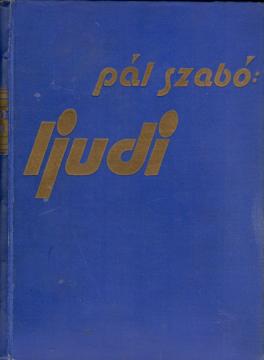
Ljudi
Antique

Ljudi

Pal Szabo

"People" by Pál Szab is a romanticized chronicle of a rural community in which, through everyday life, conflicts, work, and interpersonal relationships, the moral strength, weaknesses, and constant struggle of man for dignity are depicted.

People by Hungarian writer Pál Szabo is a realistic and socially penetrating novel that presents a broad picture of life in a rural community at the turn of the 19th and 20th centuries. The work focuses on ordinary people — peasants, workers, women, young and old — whose lives are marked by hard work, social inequalities, but also a strong sense of community. Szabo depicts the mentality of the rural environment in a classically realistic manner: the struggle for survival, dependence on the land, seasonal rhythms, but also the emotional tensions that arise from close, almost closed coexistence in a small community.

The novel does not have a single central character; instead, the focus is on the entire collective, where individual destinies are intertwined with social changes. In this sense, “People” functions as a kind of panorama of life: it depicts love and jealousies, family disagreements, generational differences, poverty, the pursuit of a better life, and the relationship to tradition. Szabo also highlights the moral dilemmas of the characters, exploring how external circumstances shape human nature and decisions.

The novel's particular value lies in its detailed descriptions of everyday life — from work in the fields to customs, superstitions, and the village as a social organism. The author builds a style that is both simple and poetic, wanting to emphasize that the lives of "little people" are just as worthy of literary depiction as the fates of great heroes.

People is therefore a novel about struggle, endurance, and the moral complexity of ordinary lives, a work that leaves an impression of documentary credibility and deep humanistic empathy for its characters.

Original title
Emberek regény
Translation
Andrija Kovačević
Dimensions
20 x 14 cm
Pages
252
Publisher
Binoza, Zagreb, 1932.
 
Latin alphabet. Hardcover.
Language: Croatian.

One copy is available

Condition:Used, very good condition
Damages or inconvenience notice:
  • The cover is missing
 

Are you interested in another book? You can search the offer using our search engine or browse books by category.

You may also be interested in these titles

Stotina godina (antikronika)

Stotina godina (antikronika)

Dario Harjaček

The novel One Hundred Years by Dario Harjaček provides a panoramic view of Trešnjevka and its inhabitants through a century of changes, ideologies, and human destinies – a mosaic of Zagreb in which life, art, and history intertwine.

Oceanmore, 2025.
Croatian. Latin alphabet. Paperback.
13.42
Tri mušketira 1-2

Tri mušketira 1-2

Alexandre Dumas

Dumas' version of the story depicts the adventures of d'Artagnan and his friends from 1625 to 1628.

Epoha, 1966.
Croatian. Latin alphabet. Hardcover with dust jacket.
The book consists of two volumes
9.48
Oganj - dnevnik jedne kaplarije (prva polovica)

Oganj - dnevnik jedne kaplarije (prva polovica)

Henri Barbusse
Naklada kraljevske zemaljske tiskare, 1919.
Croatian. Latin alphabet. Hardcover.
6.99
Glad na ledini

Glad na ledini

Agustin Stipčević
Zora, 1968.
Croatian. Latin alphabet. Hardcover with dust jacket.
5.22
Pišem ti priču : zbirka kratkih priča 6. natječaja za kratku priču Gradske knjižnice Samobor

Pišem ti priču : zbirka kratkih priča 6. natječaja za kratku priču Gradske knjižnice Samobor

Maja Klisurić, Draženka Robotić
Vlastita naklada, 2018.
Croatian. Latin alphabet. Paperback.
2.90
Bilješka o piscu: Neljubavni roman

Bilješka o piscu: Neljubavni roman

Julijana Matanović

A Writer's Note is the first bestseller by beloved Croatian author Julijana Matanović. A hit since its publication, the novel reminds us that the past cannot be erased, only understood.

Mozaik knjiga, 2002.
Croatian. Latin alphabet. Paperback.
6.365.09 - 6.38