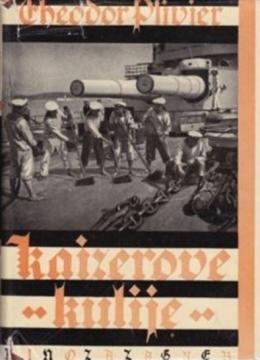
Kaiserove kulije: roman njemačke ratne mornarice
Antique

Kaiserove kulije: roman njemačke ratne mornarice

Theodor Plievier

The Kaiser's Coolies (1930) is an anti-militarist novel by Theodor Plievier. Based on his own experience, it depicts the brutal life of ordinary sailors in the German navy during World War I and the sailors' mutiny of 1917.

Theodor Plievier (1892–1955), a German writer of leftist convictions, is known for his documentary war novels (Stalingrad, Moscow, Berlin). The Kaiser's Coolies is his first and one of his most successful novels, published in 1930.

The work is a strong anti-militarist indictment of World War I and the German Imperial Army. Plievier, who himself served in the navy (among others on the SMS Wolf), realistically and documentaryally depicts the everyday life of ordinary sailors – the "coolies" (coolies, slaves) of Kaiser Wilhelm. They live in miserable conditions, under constant terror from the officer caste, meaningless exercises and the fear of death at sea.

The novel follows life on warships, naval battles (especially the Skagerrak in 1916), everyday suffering and the gradual awakening of resistance. The climax is the sailors' mutiny in 1917, which resulted in the execution of two sailors - the novel is dedicated to them. Plievier mixes autobiographical elements with extensive historical research, creating a documentary style that he later perfected in the trilogy about the Second World War.

The work quickly gained international success and was called the "Remarque of the Fleet" because of its strong pacifist message. The Nazis banned it in 1933, and stripped the author of his citizenship. The style is direct, harsh and realistic - without pathos, but with deep compassion for the common man. It criticizes militarism, class inequality in the army and the senselessness of war waged in the interests of the elite.

In Croatian literary reception, the novel was a popular interwar title that gave readers an insight into the horrors of the First World War from the perspective of an ordinary soldier. Today it is read as a classic anti-militaristic work and an important example of a 20th-century documentary novel.

Original title
Des Kaisers Kulis
Translation
Rudolf Crnić
Graphics design
Zdenka Turkalj
Dimensions
21 x 14 cm
Pages
305
Publisher
Naklada Binoza, Zagreb, 1934.
 
Latin alphabet. Hardcover with dust jacket.
Language: Croatian.

One copy is available

Condition:Used, very good condition
Damages or inconvenience notice:
  • The cover is missing
 

Are you interested in another book? You can search the offer using our search engine or browse books by category.

You may also be interested in these titles

Put u Jajce

Put u Jajce

Edvard Kocbek

In Put u Jajce, Edvard Kocbek provides personal and political testimony about key moments in Yugoslav history. The book is based on Kocbek's memories from the Second World War, especially the trip to Jajce in 1943.

Znanje, 1978.
Croatian. Latin alphabet. Hardcover with dust jacket.
8.38
Djeca jedne zime

Djeca jedne zime

Dea Trier Morch

A documentary novel that follows the experiences of women in the maternity ward of Copenhagen City Hospital over the course of one month. The novel, in the form of a diary entry, follows the pregnancy and childbirth of six women at a gynecological clinic.

Globus, 1987.
Croatian. Latin alphabet. Hardcover with dust jacket.
4.52 - 5.62
Pisma Cosimu I. Mediciju 1566.

Pisma Cosimu I. Mediciju 1566.

Marin Držić

Držić's letters to Cosimo I de' Medici represent a significant document of Croatian Renaissance literature and history. Držić sent three letters to Cosimo I, Grand Duke of Tuscany, between June and August 1566, while he was staying in Florence.

Croatian P.E.N. Centre & Most / The Bridge, 1993.
Croatian. Latin alphabet. Paperback.
8.32
Tri sata: Roman međimurskog preokreta 1918.

Tri sata: Roman međimurskog preokreta 1918.

Đuro Vilović

The work, first published in 1935, provides a documentary account of events related to the liberation of Međimurje from Hungarian rule and its annexation to the Kingdom of Serbs, Croats and Slovenes in 1918.

Naklada Binoza, 1935.
Croatian. Latin alphabet. Hardcover.
7.95
Urotnička pisma Marina Držića - s faksimilima pisama

Urotnička pisma Marina Držića - s faksimilima pisama

Marin Držić

The Conspiratorial Letters of Marin Držić represent an exceptionally important document of Croatian political and literary history of the 16th century. With a reprint of the original manuscript of the Conspiratorial Letters and the "bill of exchange" of M

Sveučilišna naklada Liber (SNL), 1989.
Croatian. Latin alphabet. Paperback.
21.46