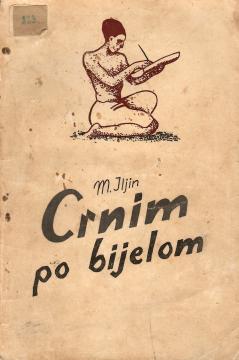
Crnim po bijelom – priče o knjigama
Rare book

Crnim po bijelom – priče o knjigama

Mihailo J. Iljin

A popular science book for young people about the history of writing, books, and printing — from prehistoric drawings to the modern printing press. A lively, accessible style by a Soviet author with illustrations by N. Lapshin.

The work Black on White by the Soviet author Mikhail Yakovlevich Ilyin (real name Ilya Yakovlevich Marshak, 1896–1953) is a classic of popular science literature for children and young people. Ilyin, brother of the famous poet Samuil Marshak, was a master of writing understandable and interesting books about science and technical progress.

The content follows the history of the book chronologically and thematically: from the first human writings on stones, bones and clay, through Egyptian papyrus, parchment, Chinese paper, medieval manuscripts, illuminated codices, to Gutenberg's invention of the printing press and modern mass production of books. Ilyin vividly describes how each change in material and technique (from drawing "black on white") influenced the spread of knowledge, culture and education. He particularly emphasizes the role of the book in the fight against ignorance and its democratic potential.

The style is dynamic, narrative and full of interesting anecdotes, which is typical of Ilyin's books (Stories about things, Creation of a new world, etc.). Although it was created in the Soviet context, this book is relatively universal and less ideologically burdened than some other works of that era. In post-war Yugoslavia, it fit in well with efforts to popularize knowledge and reading among young people.

Original title
Чёрным по белому
Translation
Radivoje V. Teodosić
Illustrations
Nikolaj Ustinovič Lapšin
Dimensions
20 x 13 cm
Pages
111
Publisher
Nakladni zavod Hrvatske, Zagreb, 1946.
 
Latin alphabet. Paperback.
Language: Croatian.

One copy is available

Condition:Used, very good condition
Damages or inconvenience notice:
  • Traces of patina
 

Are you interested in another book? You can search the offer using our search engine or browse books by category.

You may also be interested in these titles

Djela #15: Pripovetke / Drame

Djela #15: Pripovetke / Drame

Maksim Gorki

The book contains the following stories and plays: Three Days, Theft, Criminals, Thefts, Fake Money and The Old Man.

Kultura, 1949.
Serbian. Latin alphabet. Hardcover.
4.56
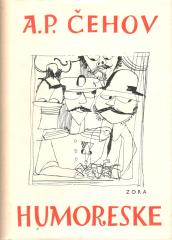
Sabrana djela A. P. Čehova #1: Humoreske

Sabrana djela A. P. Čehova #1: Humoreske

Anton Pavlovič Čehov

This book includes Chekhov's works from 1880-1885, i.e. humoresques, short stories, and sketches, starting with Letters to a Learned Neighbor, which Chekhov considered the beginning of his literary career.

Zora, 1959.
Croatian. Latin alphabet. Hardcover with dust jacket.
9.54
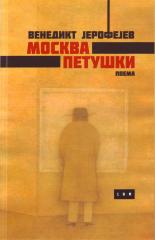
Moskva – Petuški

Moskva – Petuški

Venjedikt Jerofejev

Venedikt Yerofeyev's postmodern prose poem is today considered a classic of new Russian literature. It is compared to Gogol and Kharms for its poetics of absurdity, satire, and metaphysical depth.

LOM, 217.
Serbian. Cyrillic alphabet. Paperback.
11.24
Uzorana ledina 1-2

Uzorana ledina 1-2

Mihail Šolohov

The novel is set in a Cossack community on the Don River during collectivization in the Soviet Union. The work, divided into two parts, follows the dramatic changes in the village of Gremyachi Log as the Bolsheviks introduce collective farms, which provok

Svjetlost, 1979.
Serbian. Latin alphabet. Hardcover.
The book consists of two volumes
5.00 - 13.96
Zlatno tele

Zlatno tele

Ilja Iljf, Jevgenij Petrov

The Golden Calf (1931) is a brilliant satirical picaresque adventure, a sequel to the legendary 12 Chairs, where the great schemer Ostap Bender returns in full glory – charming, cynical, irredeemably cunning and always one step ahead of everyone else.

Kultura, 1946.
Croatian. Latin alphabet. Hardcover with dust jacket.
7.56
Pomalo neobični slučajevi

Pomalo neobični slučajevi

Daniil Ivanovič Harms

The second edition of stories, sketches, anecdotes and shorter pieces by a distinctive Russian writer who has gained numerous fans among the Croatian reading public, primarily because of the laughter that balances on a thin line - the dividing line betwee

Šareni dućan, 2001.
Croatian. Latin alphabet. Paperback.
10.26