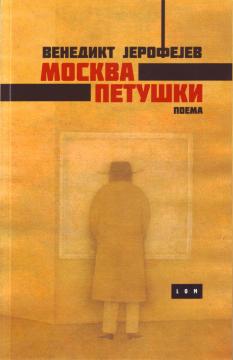
Moskva – Petuški
Rare book

Moskva – Petuški

Venjedikt Jerofejev

Venedikt Yerofeyev's postmodern prose poem is today considered a classic of new Russian literature. It is compared to Gogol and Kharms for its poetics of absurdity, satire, and metaphysical depth.

Moscow – Petushki is a postmodern prose poem by Venedikt Yerofeyev (1938–1990), written in 1969–1970 in samizdat, published in Russia only in 1989 (during perestroika), and today it is considered a classic of new Russian literature and the last great Soviet myth. It is compared to Gogol and Kharms for its poetics of absurdity, satire, and metaphysical depth.

The story is pseudo-biographical: the lyrical hero Venichka (the author's alter ego) is a thirty-year-old alcoholic intellectual, fired from his job for drawing diagrams of how much workers drank. On Friday morning, he wakes up in an unfamiliar staircase in Moscow after several days of drunkenness, remembering nothing. He wants to go to Petushki (a real town 125 km east of Moscow) – an ideal, utopian space of love, where a “unique” lover and a three-year-old son (not necessarily his) await him. At Kursk Station, he buys alcohol and boards an electric train.

The journey is an alcoholic monologue: Venichka mixes incredible cocktails (“the tear of a kermesinka”, “the first kiss”, “the tears of a bitch”), talks with fellow travelers, angels, demons, God, quotes the Bible (the words of Christ, the New Testament, death and resurrection), Russian literature, the Soviet press, philosophizes about the Russian people (“we are all like drunks, but each in his own way: one laughs in the face of the world, the other cries on his chest”), ephemerality, paralysis of the soul, courage from an early age. Petushki becomes a metaphor for an unattainable paradise – the more he drinks, the more he loses his orientation.

In reality, Venichka never reaches Petushki: in a delirium, he returns to Moscow, where he is attacked by unknown people in passing and stabbed in the neck (the author later died of throat cancer in 1990). The novel is cyclical – it begins and ends in Moscow, without leaving the circle.

Through humor, irony, blasphemy, and lyricism, Yerofeyev criticizes Soviet reality: the absurdity of bureaucracy, the spiritual emptiness, where alcohol becomes the only way out of the “absolute rot of society.” Alcohol is the engine of the story and a symbol – from euphoria to tragedy. Quotes from the Bible, Gogol, Dostoevsky, Byron, and Soviet propaganda create a dense intertextuality.

Original title
Москва — Петушки
Translation
Irena Lukšić
Editor
Flavio Rigonat
Dimensions
21 x 13.5 cm
Pages
173
Publisher
LOM, Beograd, 217.
 
Cyrillic alphabet. Paperback.
Language: Serbian.

One copy is available

Condition:Used, excellent condition
 

Are you interested in another book? You can search the offer using our search engine or browse books by category.

You may also be interested in these titles

Malena je ime tanga

Malena je ime tanga

Almudena Grandes

If you like raw eroticism like Cloud Atlas, this is a sensual saga – emotional, provocative, for those who want to feel the pulse of forbidden passion! Grandes probes whether love is a curse or a liberation?

Mozaik knjiga, 2000.
Croatian. Latin alphabet. Hardcover.
8.54
Rudnik čvaraka

Rudnik čvaraka

Tomislav Šovagović

The debut work of Croatian writer Tomislav Šovagović, awarded the Josip and Ivan Kozarac Award in 2012, is a dedication to Slavonia – the region of his childhood that the author, born in Dalmatia, observes with foreign but tender eyes.

Mozaik knjiga, 20112.
Croatian. Latin alphabet. Paperback.
11.56
Ljubičice u srijedu

Ljubičice u srijedu

Andre Maurois

André Maurois, a French writer known for his psychological novels and biographies, explores themes of family relationships, love, and internal conflicts in this work, which is characteristic of his style.

Svjetlost, 1965.
Croatian. Latin alphabet. Paperback.
3.42 - 3.62
Amandino vjenčanje

Amandino vjenčanje

Jenny Colgan

A romantic comedy about friendship, love, and the chaotic attempts to save a good man from a bad marriage. A chick-lit hit, it reminds us that friendship saves more than any plan, and love comes unexpectedly.

Znanje, 2001.
Croatian. Latin alphabet. Paperback.
5.36
Krčma

Krčma

Julian Stryjkowski

The book "Inn" by Julian Stryjkowski, published in 1977, explores life in a small Jewish village in Galicia during the 19th century.

BIGZ, 1977.
Serbian. Latin alphabet. Paperback.
4.38
Deobe

Deobe

Dobrica Ćosić

Deobe is a novel about the tragic division of Serbs into Chetniks and Partisans during World War II. Winner of the NIN Award, it is part of a wider epic trilogy, inspired by Ćosić's experiences and historical documents.

Prosveta, 1963.
Croatian. Latin alphabet. Hardcover with dust jacket.
13.74