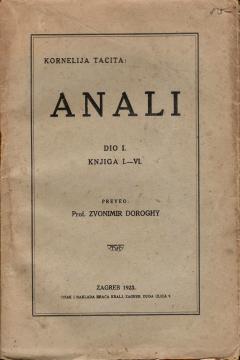
Anali: Dio I. (knjiga I.–VI.)
The first part of Tacitus' famous work on the early Roman Empire, covering the period from the death of Augustus to the end of the reign of Tiberius. The second part was not published in this edition. The first translation of the Annals into Croatian.
The Annals of Cornelius Tacitus is one of the most significant works of ancient historiography. In sixteen books (of which the first six and part of the later ones, namely books XI–XVI, have been preserved), Tacitus describes Roman history from the death of Emperor Augustus in 14 AD to the death of Nero in 68 AD.
The work is known for its sharp, concise and deeply pessimistic analysis of Roman politics, court intrigues, tyranny and the decline of freedom under the imperial system. Books I–VI, which deal with the reign of Tiberius – a period marked by Sejanus' conspiracy, Germanicus' mysterious death, the trials for treason and increasing despotism, are particularly impressive.
Tacitus does not simply chronicle events, but provides an extraordinary psychological analysis of power, hypocrisy and corruption. His style – lapidary, ironic and moralistic – is considered the pinnacle of Roman prose.
The Croatian edition from 1923 brings books I–VI in the translation by Zvonimir Doroghy. It was published by the reputable Zagreb publishing house Braća Kralj as a standalone book. This was the first translation of these books into Croatian and part of the efforts of interwar Croatian publishers to make classical literature accessible to the domestic audience and schoolchildren.
Doroghy's translation attempts to preserve Tacitus' brevity and force of expression, adapting it to the Croatian language of the time. New translations followed later (e.g. by Jakov Kostović in 1970), but Doroghy's edition from 1923 remains an important part of the history of the reception of ancient literature by Croats.
This book thus connects two worlds: a superb Roman literary and historical work of the 2nd century with the Croatian cultural scene of the 1920s, when the national fund of translations of classical literature was systematically being built. Today, the publication by the Kralj brothers is a bibliographical rarity and a valuable witness to the development of Croatian classical philology and publishing in the interwar period.
One copy is available
- Restored spine