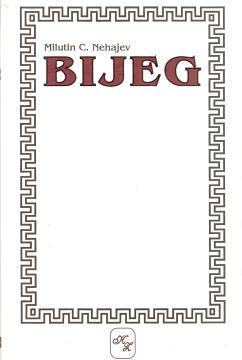
Bijeg
A psychological novel about the downfall of the gifted intellectual Đuro Andrijašević, who flees from reality but finds no salvation in either the city or the province. A classic of Croatian modernism (1909).
The 1996 edition, adapted from the 1917 edition, has once again brought to life one of the most important novels of Croatian literary modernity. The work was first published in 1909 and is considered the best novel of Croatian modernity.
The novel follows the life of Đuro Andrijašević, a gifted but emotionally unstable young intellectual. The plot begins on the train on which Đuro returns from Vienna to Slavonia, and is mostly told through his memories, diary entries and internal monologues. The reader follows his childhood in Senj, his education in Rijeka and Vienna, his student days, love affairs (Zora, Vera), financial and existential crises and finally the life of a provincial professor in Senj.
Nehajev masterfully depicts defabularization – the plot is slower, and the emphasis is on psychological analysis, the state of consciousness and the internal conflicts of the main character. Đuro is a typical superfluous man of modernity: talented, sensitive, full of ideals, but unable to face the reality of a petty-bourgeois environment, financial problems and social expectations. His escape from reality (into alcohol, literature, love or the provinces) ends tragically – in decline and complete impotence.
The work contains strong autobiographical elements (Nehajev, like Đuro, studied in Vienna, lived in the provinces and dealt with internal crises). It combines social criticism, psychological depth and modern storytelling techniques (monologues, letters, diary). Critics often compare it to the works of Turgenev, Flaubert and Goncharov (Oblomov).
Today, Escape is considered a classic reading and one of the most representative works depicting the crisis of the intellectual at the turn of the 19th and 20th centuries in Croatian society. With this novel, Nehajev (1880–1931) left a deep mark as a prominent representative of Croatian modernism – a novelist, playwright, and critic.
One copy is available