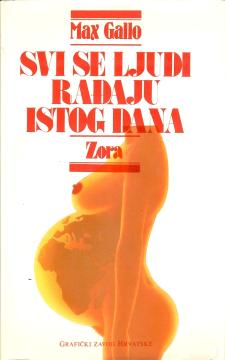
Svi se ljudi rađaju istog dana: Zora

Svi se ljudi rađaju istog dana: Zora

Max Gallo

The first part of Gall's saga follows seven children born on January 1, 1900 in different parts of the world and shows how the beginning of the 20th century divides them from birth by class, power, and destiny.

Dawn, the first part of the novel All People Are Born on the Same Day, starts from a precise and powerful idea: on January 1, 1900, seven children are born in different places around the world. With this, Max Gallo immediately establishes the framework of the plot - this is not the story of a single hero, but of a generation entering the 20th century from completely different starting positions. Among them are children born into wealth, into politically influential families or into socially privileged environments, but also those whose lives will be defined from the beginning by insecurity, inequality and belonging to the fringes of a world that does not have the same power.

The historical context of the novel is not an incidental backdrop but the main mechanism of the plot. Dawn covers the beginning of the 20th century - a period of industrial growth, strong class differences, colonial relations, imperial ambitions and the belief that the new century will bring progress. Gallo shows that people are formally born on the same day, but not in the same conditions: some are protected from the beginning by capital and family position, while others are shaped by poverty, social subordination and limited choice.

The plot develops in parallel, through their families, upbringing, first relationships, ambitions and first contacts with a society that classifies them before they can choose anything for themselves. That is why Dawn is a novel about the early formation of destiny: about how a century begins with the promise of progress, but from the very beginning produces differences that will later grow into conflicts, fractures and unequal lives. The titular "dawn" thus signifies not only the beginning of life but also the beginning of a world that shapes its heroes unequally from the first day.

Original title
Les hommes naissent tous le meme jour: Aurore
Translation
Branka Golubović
Editor
Nenad Popović
Graphics design
Zoran Pavlović
Dimensions
19.5 x 12 cm
Pages
341
Publisher
Grafički zavod Hrvatske (GZH), Zagreb, 1981.
 
Latin alphabet. Hardcover with dust jacket.
Language: Croatian.

One copy is available

Condition:Unused
 

Are you interested in another book? You can search the offer using our search engine or browse books by category.

You may also be interested in these titles

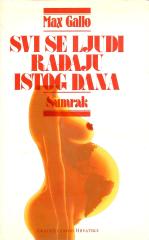
Svi se ljudi rađaju istog dana: Sumrak

Svi se ljudi rađaju istog dana: Sumrak

Max Gallo

In Twilight, the lives of seven people born in 1900 break under the weight of the wars, ideologies, and violence of the 20th century, as the initial promises of the era give way to loss, division, and historical darkness.

Grafički zavod Hrvatske (GZH), 1981.
Croatian. Latin alphabet. Hardcover with dust jacket.
7.42
Bartolomejska noć: knjiga 1-2

Bartolomejska noć: knjiga 1-2

Alexandre Dumas

This book focuses on one of the bloodiest events in French history – St. Bartholomew's Day in 1572, when thousands of French Protestants were massacred in Paris and across the country.

Epoha, 1966.
Croatian. Latin alphabet. Hardcover with dust jacket.
The book consists of two volumes
9.36
Pariški pokolj

Pariški pokolj

Jean Cassou
Naklada Binoza, 1936.
Croatian. Latin alphabet. Hardcover with dust jacket.
19.74 - 21.46
Evgenija Grande

Evgenija Grande

Honore de Balzac

"Eugénie Grandet" (1833), part of Balzac's Human Comedy, is a realistic novel that explores greed, family relationships, and the sacrifices of love in provincial French society.

Veselin Masleša, 1989.
Croatian. Latin alphabet. Hardcover.
4.98
Četrdeset pet vitezova, sv. 1-2

Četrdeset pet vitezova, sv. 1-2

Alexandre Dumas

Alexandre Dumas – The Forty-Five Knights, published in 1966, is part of a grand trilogy about the political and religious turmoil in France during the late 16th century.

Epoha, 1966.
Croatian. Latin alphabet. Hardcover with dust jacket.
The book consists of two volumes
9.48
Ljubavnici sa Tahoa

Ljubavnici sa Tahoa

Joseph Kessel

The plot is set in Lisbon, along the Tagus River, and follows an emotional and complex love story intertwined with dramatic elements.

Minerva, 1987.
Serbian. Latin alphabet. Hardcover.
4.98