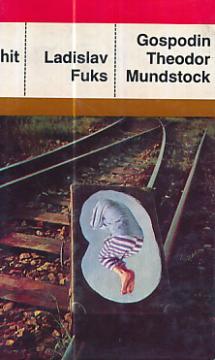
Gospodin Theodor Mundstock

Gospodin Theodor Mundstock

Ladislav Fuks

Ladislav Fuks's "Mr. Theodor Mundstock" follows a lonely Jew in occupied Prague who, expecting deportation to a concentration camp, mentally and physically prepares himself for survival.

“Mr. Theodor Mundstock” (1963) is a psychological novel by Czech writer Ladislav Fuchs, set in Prague during the Nazi occupation. The main character, Theodor Mundstock, a reclusive Jewish clerk, lives in constant fear of deportation to a concentration camp. Aware that he cannot escape his fate, he tries to prepare for it in the only way he considers possible – through daily exercises and discipline. In his apartment, he simulates the conditions of camp life: he gets used to hunger, hard physical labor, prolonged standing, sleeping on a hard surface, and renouncing basic necessities. At the same time, he has imaginary conversations with his imaginary companion Mona, who represents his inner voice, fears, and hopes.

The novel does not directly describe the horrors of concentration camps, but rather the psychological state of a man living in anticipation of a catastrophe. Fuchs masterfully depicts how constant fear destroys the personality, but also how a man tries to preserve dignity and the meaning of life in hopeless circumstances. Theodor is an ordinary, humble man who does not fight with weapons, but strives to overcome his own fear and preserve his humanity. The tragic irony of the novel is reflected in its ending: after long preparations for deportation, Mundstock dies in a car accident just before he is taken to the camp. The work is a strong anti-war and humanistic message about the consequences of persecution, totalitarianism and dehumanization, but also about the inner strength of an individual who faces an inevitable fate.

Original title
Pan Theodor Mundstock
Translation
Anka Katušić Balen
Editor
Zlatko Crnković
Illustrations
Vladimir Jakolić
Graphics design
Alfred Pal
Dimensions
19.5 x 12 cm
Pages
248
Publisher
Znanje, Zagreb, 1988.
 
Latin alphabet. Hardcover with dust jacket.
Language: Croatian.

One copy is available

Condition:Used, excellent condition
 

Are you interested in another book? You can search the offer using our search engine or browse books by category.

You may also be interested in these titles

Tijela i duhovi

Tijela i duhovi

Mirko Božić

Bodies and spirits is the third part of the Kurlan trilogy by Mirko Božić, published in 1981, which follows the novels Kurlani (1952) and Neisplakani (1955).

Znanje, 1981.
Croatian. Latin alphabet. Hardcover with dust jacket.
4.98
Ljubavlju opsjednuti

Ljubavlju opsjednuti

Terje Stigen

Obsessed with Love by Terje Stigen is a novel about a love affair that gradually turns into an obsession. Through conflicts, jealousy, and emotional dependence, it depicts the destructive power of uncontrolled passion.

Znanje, 1975.
Croatian. Latin alphabet. Hardcover with dust jacket.
3.98
Slobodni pad

Slobodni pad

Pavao Pavličić

Pavličić's novel deals with the psychological and ethical consequences of human choices in extreme circumstances. It is not just a novel about a man in crisis, but also a study of how a person reacts when they lose their support - in themselves, in others

Znanje, 1982.
Croatian. Latin alphabet. Hardcover with dust jacket.
3.76 - 6.464.52
Čovjek sa bezbroj imena

Čovjek sa bezbroj imena

Graham Greene

Young Victor Baxter grows up under the guardianship of the mysterious Captain and the woman who gives him a new name – Jim. His search for the truth about their identities leads him to discoveries about love, betrayal and his own life.

Znanje, 1989.
Croatian. Latin alphabet. Hardcover with dust jacket.
4.76 - 5.36
Plavi bicikl

Plavi bicikl

Regine Deforges

The Blue Bicycle by Régine Deforges is a historical romance novel set in France during World War II. The main character, Léa Delmas, goes through the horrors of war, romantic conflicts, and personal maturation.

Znanje, 1987.
Croatian. Latin alphabet. Hardcover with dust jacket.
3.36 - 3.42
Zajednička kupka

Zajednička kupka

Ranko Marinković

The communal bath is a kind of recapitulation - in it, Marinković's obsessive motives (humiliation, fraud and death) are discussed in the most direct and immediate way. In one of its layers, the novel is also a metaphor for literature, an allegory about t

Znanje, 1980.
Croatian. Latin alphabet. Hardcover with dust jacket.
8.56