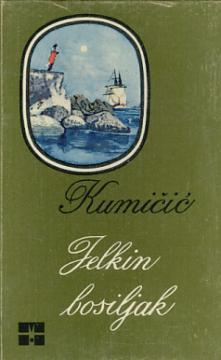
Jelkin bosiljak / Preko mora

Jelkin bosiljak / Preko mora

Eugen Kumičić

Two tales of Istrian life: "Jelka's Basil" tells a story of tragic love and fidelity, while "Across the Sea" depicts the arduous fate of Istrian emigrants in search of a better life.

The diptych comprising Jelka’s Basil (1881) and Across the Sea (1882) represents a body of exceptionally important works by Eugen Kumičić, in which the author returns to his native Istria to portray the authentic lives, customs, and arduous fates of the Istrian people in the late 19th century. The story Jelka’s Basil is a poignant and tragic love story about a young woman named Jelka and her fiancé, the sailor Ivo. Through the symbolism of basil—a flower representing devotion and love—Kumičić depicts the suffering, uncertainty, and longing of those left on the shore, awaiting the return of their loved ones from perilous seas. The story radiates warmth, regional color, and emotional intensity. In contrast, Across the Sea focuses on a pressing social issue of the era: the forced emigration of Istrian peasants. Driven by poverty, exploitation by Venetian and Austrian authorities, and various misfortunes, the locals are compelled to leave their homeland and embark on an uncertain journey to South America. In both works, Kumičić skillfully blends elements of realism and early naturalistic techniques with strong patriotic undertones. Through the lives of ordinary people, he addresses themes of preserving national identity, the unbreakable bond with one’s native soil, and the harsh social conditions of the Istrian coast.

Editor
Vlatko Pavletić
Dimensions
20 x 13 cm
Pages
330
Publisher
Matica hrvatska, Zagreb, 1965.
 
Latin alphabet. Hardcover.
Language: Croatian.

One copy is available

Condition:Used, excellent condition
 

Are you interested in another book? You can search the offer using our search engine or browse books by category.

You may also be interested in these titles

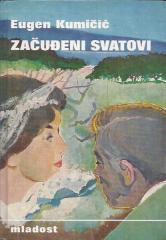
Začuđeni svatovi

Začuđeni svatovi

Eugen Kumičić
Mladost, 1979.
Croatian. Latin alphabet. Paperback.
2.98 - 2.99
Začuđeni svatovi

Začuđeni svatovi

Eugen Kumičić
Zora, 1963.
Croatian. Latin alphabet. Paperback.
1.98
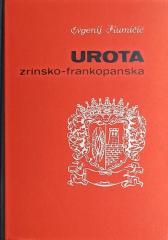
Urota Zrinsko-Frankopanska

Urota Zrinsko-Frankopanska

Eugen Kumičić

The novel "The Zrinjski-Frankopan Conspiracy" (1893) was the most widely read Croatian book for ten years, and, thanks to the interest of readers at the time in historical events, it had a huge influence on younger generations of readers.

Matica hrvatska, 1965.
Croatian. Latin alphabet. Hardcover.
8.56
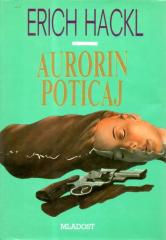
Aurorin poticaj

Aurorin poticaj

Erich Hackl

The work is based on a true event that occurred in Spain in 1933: Aurora Rodriguez killed her daughter Hildegart, a famous fighter for women's emancipation and a cult figure on the political scene of the time.

Mladost, 1990.
Croatian. Latin alphabet. Hardcover with dust jacket.
4.963.74 - 4.984.96
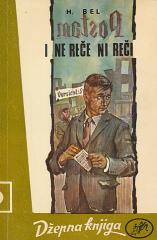
I ne reče ni reči

I ne reče ni reči

Heinrich Böll

In Boll's novels, one of the central themes is the attempt to preserve basic moral values ​​in a time of terror, as well as in a period of material prosperity and corruption.

Svjetlost, 1965.
Serbian. Latin alphabet. Paperback.
3.22 - 3.98
Proces

Proces

Franz Kafka

Kafka wrote The Process between 1914 and 1915, published posthumously in 1925. The novel is unfinished but with an added final chapter by Max Brod. Edition with a foreword by B. Živojinović and an afterword by Walter Killi.

BIGZ, 1990.
Serbian. Latin alphabet. Paperback.
4.26