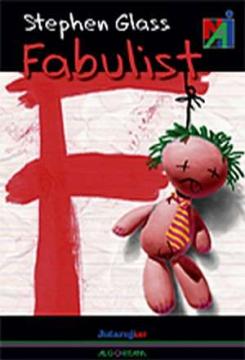
Fabulist

Fabulist

Stephen Glass

The Fabulist (2003) is a semi-autobiographical story of the rise and fall of young journalist Stephen Glass, inspired by his real-life scandal in 1998. Glass masterfully blends reality and fantasy in a hilarious yet deeply disturbing narrative.

As the shining star of The New Republic (in the novel The Washington Weekly), Glass captivated readers with his sharp articles about the powerful, but everything fell apart when rival magazine Forbes became suspicious of his story about angry lottery winners. Instead of confessing, Glass sank deeper into lies, inventing new details and characters in a desperate attempt to save his career, mixing fact with fiction like a master of illusion.

27 fake articles were discovered, his career collapsed like a house of cards, and he became a symbol of journalistic arrogance and a crisis of confidence in the media. In self-imposed exile with his family in suburban Chicago, and later near Washington, he faced demonic questions: Why am I lying? How do I stop? Is my life, at 25, lost forever?

In this chaotic escape, he encounters a colorful galaxy of eccentrics—colleague clowns, sick animals, irritable masseuses, seductive librarians, bingo contestants, synchronized swimmers, a mentally disturbed stripper, and a mysterious purple-dressed angelica—as the languid world of journalism collapses on him. He rediscovers a forgotten Judaism, falls in love with a woman with her own dark secrets, and struggles for redemption through family ties, friendships, faith, and love, searching for a way out of a labyrinth of lies.

Like a light mea culpa, the novel bites at media ethics, exploring how to survive in a world where truth is as fragile as glass. Inspired by the author’s own real-life downfall, it becomes a metaphor for the American dream: a rapid rise, a spectacular fall, and the difficult search for a new beginning.

Original title
The fabulist
Translation
Alenka Mirković
Editor
Neven Antičević
Illustrations
Igor Kordej
Dimensions
23.5 x 15 cm
Pages
332
Publisher
Jutarnji list, Zagreb, 2005.
 
Latin alphabet. Paperback.
Language: Croatian.
ISBN
9-53-220245-5

Multiple copies are available

Copy number 1

Condition:Used, excellent condition

Copy number 2

Condition:Used, excellent condition

Copy number 3

Condition:Used, excellent condition
 

Are you interested in another book? You can search the offer using our search engine or browse books by category.

You may also be interested in these titles

Proces

Proces

Franz Kafka

Kafka wrote The Process between 1914 and 1915, published posthumously in 1925. The novel is unfinished but with an added final chapter by Max Brod. Edition with a foreword by B. Živojinović and an afterword by Walter Killi.

BIGZ, 1990.
Serbian. Latin alphabet. Paperback.
4.26
Strasti i druge pripovijetke

Strasti i druge pripovijetke

Isaac Bashevis Singer

Winner of the Nobel Prize for Literature in 1978, Isaac Bashevis Singer is a prolific writer of novellas and short stories. And in this collection of short stories, the author's penchant for mysticism, grotesque, folklore and eroticism is expressed.

Svjetlost, 1986.
Croatian. Latin alphabet. Hardcover with dust jacket.
6.42
Ulazeći u Varcar

Ulazeći u Varcar

Ivan Lovrenović

The hybrid book – a novel, poem and essay in one – is a dedication to his native Varcar, a small village in central Bosnia, where the author's roots intertwine with the history, myth and chaos of the 20th century.

Fraktura, 2016.
Croatian. Latin alphabet. Hardcover with dust jacket.
14.42
Malena je ime tanga

Malena je ime tanga

Almudena Grandes

If you like raw eroticism like Cloud Atlas, this is a sensual saga – emotional, provocative, for those who want to feel the pulse of forbidden passion! Grandes probes whether love is a curse or a liberation?

Mozaik knjiga, 2000.
Croatian. Latin alphabet. Hardcover.
8.546.40
Dok ležah na samrti

Dok ležah na samrti

William Faulkner

Faulkner's 1930 novel, a classic example of modernist literature. It is often compared to Joyce's "Ulysses" for its innovative structure, but is more accessible due to its focus on family.

Rad, 1985.
Croatian. Latin alphabet. Paperback.
3.26
Usta puna zemlje

Usta puna zemlje

Branimir Šćepanović

The novel "Usta puna zemlje" (1970), the masterpiece of the Serbian writer Branimir Šćepanović, is a psychologically in-depth explorer of the limits of the human soul, solitude and existential freedom, reminiscent of Kafka and Camus.

BIGZ, 1987.
Serbian. Latin alphabet. Paperback.
3.96 - 3.98