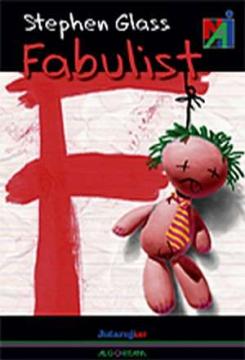
Fabulist

Fabulist

Stephen Glass

The Fabulist (2003) is a semi-autobiographical story of the rise and fall of young journalist Stephen Glass, inspired by his real-life scandal in 1998. Glass masterfully blends reality and fantasy in a hilarious yet deeply disturbing narrative.

As the shining star of The New Republic (in the novel The Washington Weekly), Glass captivated readers with his sharp articles about the powerful, but everything fell apart when rival magazine Forbes became suspicious of his story about angry lottery winners. Instead of confessing, Glass sank deeper into lies, inventing new details and characters in a desperate attempt to save his career, mixing fact with fiction like a master of illusion.

27 fake articles were discovered, his career collapsed like a house of cards, and he became a symbol of journalistic arrogance and a crisis of confidence in the media. In self-imposed exile with his family in suburban Chicago, and later near Washington, he faced demonic questions: Why am I lying? How do I stop? Is my life, at 25, lost forever?

In this chaotic escape, he encounters a colorful galaxy of eccentrics—colleague clowns, sick animals, irritable masseuses, seductive librarians, bingo contestants, synchronized swimmers, a mentally disturbed stripper, and a mysterious purple-dressed angelica—as the languid world of journalism collapses on him. He rediscovers a forgotten Judaism, falls in love with a woman with her own dark secrets, and struggles for redemption through family ties, friendships, faith, and love, searching for a way out of a labyrinth of lies.

Like a light mea culpa, the novel bites at media ethics, exploring how to survive in a world where truth is as fragile as glass. Inspired by the author’s own real-life downfall, it becomes a metaphor for the American dream: a rapid rise, a spectacular fall, and the difficult search for a new beginning.

Titel des Originals
The fabulist
Übersetzung
Alenka Mirković
Editor
Neven Antičević
Illustrationen
Igor Kordej
Maße
23,5 x 15 cm
Seitenzahl
332
Verlag
Jutarnji list, Zagreb, 2005.
 
Latein Schrift. Taschenbuch.
Sprache: Kroatisch.
ISBN
9-53-220245-5

Weitere Exemplare sind verfügbar

Kopiennummer 1

Zustand:Gebraucht, in ausgezeichnetem Zustand
Zum Warenkorb hinzugefügt!

Kopiennummer 2

Zustand:Gebraucht, in ausgezeichnetem Zustand
Zum Warenkorb hinzugefügt!

Kopiennummer 3

Zustand:Gebraucht, in ausgezeichnetem Zustand
Zum Warenkorb hinzugefügt!
 

Interessieren Sie sich für ein anderes Buch? Sie können das Angebot über unsere Suchmaschine suchen und finden oder Bücher nach Kategorien durchsuchen.

Diese Titel könnten Sie auch interessieren

Bijelo ciganče

Bijelo ciganče

Vidoe Podgorec

Die Geschichte eines Jungen namens Tarun, der seine Eltern im Krieg verlor, nachdem sie von den Nazis getötet worden waren. Er wurde am Straßenrand ausgesetzt, wo ihn wandernde Roma fanden und ihn adoptierten. Wegen seiner hellen Haut nannten sie ihn „Wei

Svjetlost, 1989.
Kroatisch. Latein Schrift. Hardcover.
4,36
Pismo nerođenu djetetu: Svjedočanstvo pobunjene žene

Pismo nerođenu djetetu: Svjedočanstvo pobunjene žene

Oriana Fallaci

Der berührende und schmerzlich ehrliche Dialog einer Mutter mit ihrem ungeborenen Kind, geschrieben von der berühmten italienischen Journalistin und Schriftstellerin Oriana Fallaci, begeistert seit Jahrzehnten Generationen von Lesern auf der ganzen Welt.

Znanje, 1980.
Kroatisch. Latein Schrift. Taschenbuch.
4,26
Čovjek u svojoj sjeni

Čovjek u svojoj sjeni

Jakov Sekulić
Zora, 1969.
Kroatisch. Latein Schrift. Fester Einband mit Schutzumschlag.
3,45 - 3,46
Shannonov put

Shannonov put

Archibald Joseph Cronin
Otokar Keršovani, 1966.
Kroatisch. Latein Schrift. Taschenbuch.
4,99
Sumka 43

Sumka 43

Josip Novaković
Sandorf, 2017.
Kroatisch. Latein Schrift. Taschenbuch.
9,99
Listopad

Listopad

Mate Beretin
Naprijed, 1958.
Kroatisch. Latein Schrift. Fester Einband mit Schutzumschlag.
7,50