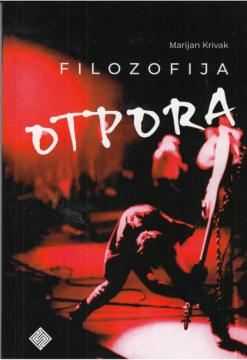
Filozofija otpora

Filozofija otpora

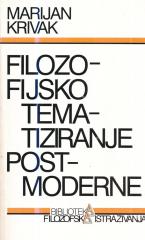
Marijan Krivak

In a world of entropic orders networked by "control societies" (Deleuze), the only thing left for us is a peculiar PHILOSOPHY OF RESISTANCE.

Resistance is like a "human too human" urge to conquer the enclave of Justice in the impotent (only) formal framework of human rights and freedoms. Furthermore, philosophy today must be in what has been called eudaimonia since Antiquity - happiness as bliss. The answer, on the other hand, to the question of what philosophy is, can only be a "philosophizing answer". Her saying "love for wisdom" is no longer sufficient for us as decisive. Heidegger and Deleuze&Guattari get the solution to their question about the "value" of philosophy - according to my deep conviction - in Badiou's peculiar "metaphysics of real happiness". The central part of the book - its interlude - deals with the phenomena of language and art, especially film. Julij Knifer's artwork (juxtaposed with Mihovil Pansini's film opus) becomes an act of freedom, therefore RESISTANCE! Both authors strive, with their anti-stance - Knifer with anti-painting, and Pansini with anti-film - to affirm the art of sàmu. How, then, to mark the place of LANGUAGE in such a "philosophy of resistance"? Language, as something that belongs most to every human entity, should be freed from its communicative purpose. We could get there if we restore LANGUAGE as the generic essence of man. Finally, reaching the language is also the medium of coming into the world (Sloterdijk). The last part of the book is dedicated to the term "fascisization". What is fascism? The term to which I return again and again needs to be explained in the operational sense of its current philosophical-theoretical usability. Is it still possible to approach the term historically and epistemologically? What is PHILOSOPHICAL RESISTANCE RESISTANCE to a senseless and conceptless world? Through this art, the revolutionary desire for an event of inhabiting a new land and people in which philosophy is born is revealed. Philosophy is re-territorialized against all the dispositifs of capital, in a "non-fascist existence, in the field of immanence."

Dimenzije
24 x 17 cm
Broj strana
171
Nakladnik
Filozofski fakultet, Osijek, 2019.
 
Tiraž: 120 primjeraka
 
Latinica. Broširano.
Jezik: Hrvatski.

Jedan primjerak je u ponudi

Stanje:Korišteno, u odličnom stanju
Dodano u košaricu!
 

Zanima Vas i neka druga knjiga? Možete pretražiti našu ponudu pomoću tražilice ili prelistati knjige po kategorijama.

Možda će Vas zanimati i ovi naslovi

Kopernikanska mobilizacija i ptolomejsko razoružanje: Ogled iz estetike

Kopernikanska mobilizacija i ptolomejsko razoružanje: Ogled iz estetike

Peter Sloterdijk

U ovom provokativnom eseju, Sloterdajk interveniše u žestokoj debati osamdesetih godina o modernizmu i postmodernizmu. Kratak, oštar tekst – neophodan za razumevanje Sloterdajkovog ranog pristupa estetici, medijima i krizi modernosti.

Svetovi, 1988.
Srpski. Latinica. Broširano s ovitkom.
8,36
Istina i estetska istina

Istina i estetska istina

Käte Hamburger

Knjiga razmatra odnos istine i umjetnosti i postavlja pitanje je li estetska istina još uvijek legitimna estetička kategorija.

Svjetlost, 1982.
Hrvatski. Latinica. Broširano.
6,524,89
Etički problem u djelu Karla Marxa

Etički problem u djelu Karla Marxa

Milan Kangrga
Naprijed, 1963.
Hrvatski. Latinica. Tvrde korice.
7,82
Oproštaj od utopije?

Oproštaj od utopije?

Ernst Bloch
Izdavački centar Komunist, 1986.
Srpski. Latinica. Tvrde korice s ovitkom.
11,98
McDonaldizacija društva

McDonaldizacija društva

George Ritzer

Das Buch ist zu einem Klassiker geworden, weil es die Welt von Amazon, Uber, Netflix und TikTok dreißig Jahre im Voraus treffend beschreibt. Ritzer verflucht nicht Fast Food, sondern warnt davor, dass wir zwar satt bleiben, aber nach Sinn hungern werden,

Jesenski i Turk, 1999.
Hrvatski. Latinica. Broširano.
19,56
Što su Česi?: kratki pregled činjenica i pokušaj objašnjenja

Što su Česi?: kratki pregled činjenica i pokušaj objašnjenja

Jan Patočka

In dem Ihnen vorliegenden Buch hat Jan Patočka einen paradigmatischen Essay über die mitteleuropäische Identität eines slawischen Volkes verfasst.

Durieux, 2000.
Hrvatski. Latinica. Broširano.
7,74